
The hotel is almost surrounded by construction sites. In the streets, as at the airport, posters with pictures of the hostages hang everywhere. I had imagined Tel Aviv differently — I had been too influenced by the marketing of Tel Aviv as a hypermodern start-up nation and had pictured the city as a kind of Singapore on the Mediterranean.
Tel Aviv has a slightly run-down, chaotic coastal-city flair and reminds me more of Naples than Singapore. I liked it more than I expected. There are no tourists in the streets; before I open my mouth, I am automatically taken for an Israeli. Apart from the posters, nothing in Tel Aviv gives any indication that only a few kilometers away, a crime of horrific proportions is taking place.
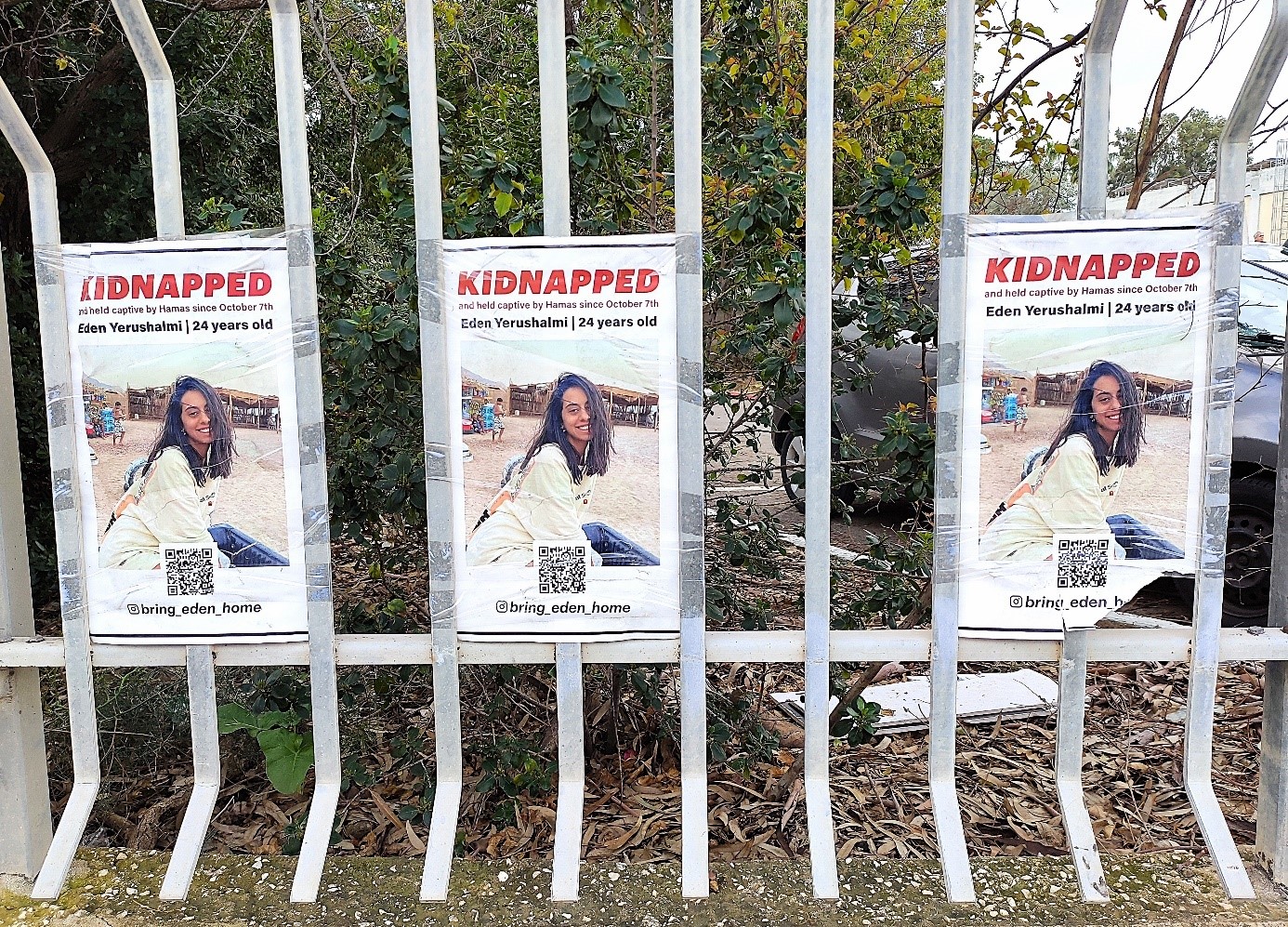
24-year-old civilian held hostage by Hamas: Eden Yerushalmi
The Plan Bears Fruit
Two days ago, on February 18, 2024, hungry, desperate Palestinians stormed food trucks in northern Gaza. The Israeli army opened fire, shot into the crowd, and killed at least one of the starving. A truck driver was attacked, which is why deliveries were suspended for the time being — they will continue to go hungry. From the Israeli perspective, everything is going according to plan.
“The pressure on Gaza is so great that Gaza has become an area where people cannot live. People cannot live until Hamas is destroyed. This means that Israel not only stops supplying energy, diesel, water, food, as we have done for the past twenty years, but we should prevent any possible support from others and create such a terrible, unbearable situation in Gaza that can last for weeks and months.” This was precisely the plan that Giora Eiland had outlined in a “Times Radio” interview on October 12, 2023. Now, three months later, it is bearing fruit.
I hail a taxi on the street, and we drive along a coastal road to my first stop, the Israeli homeland museum. The large museum, comprising several buildings, is almost deserted, and as I walk from room to room, I realize for the first time how all-encompassing the Zionist propaganda project is. The museum was not founded with the intention of approaching a historical reality.
The museum’s goal is to create a reality, to buttress the founding myth of the State of Israel, and to erase the presence of the Palestinians in “Eretz Israel.”
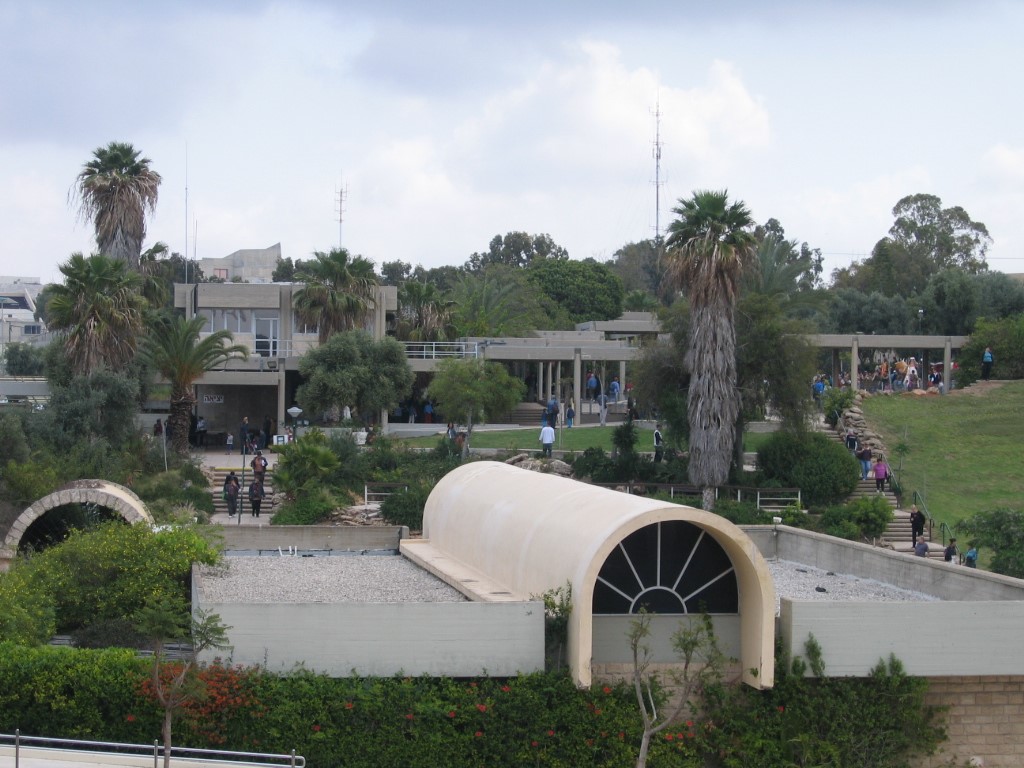
“Eretz Israel” Museum, Tel Aviv: Building block of a monumental propaganda project
According to the glossary of the Jüdische Allgemeine, “Eretz Israel” refers to the Land of Israel and is the biblical designation for the Jewish state, or the Hebrews. The term was revived after the beginning of political Zionism in the nineteenth century and is also frequently used in the State of Israel today.
Brief Introduction to Modern Zionism
Political Zionism is a nationalist movement that emerged in the late nineteenth century with the goal of establishing a colony settled by European Jews in Palestine. Palestine, a province of the Ottoman Empire for 400 years, was under British administration at the time. At the beginning of British rule in Palestine in 1920, approximately 700,000 people lived there. The population consisted of 560,000 Muslim Palestinians, 70,000 Christian Palestinians, and 76,000 Jews.
The founder of modern Zionism was Theodor Herzl (1860–1904), an Austro-Hungarian journalist and writer. Under the impression of antisemitism, particularly antisemitic pogroms in Russia, he developed the vision of a Jewish state. In 1896, he published The Jewish State, in which he advocated the founding of a Jewish state as the solution to the “Jewish question.” A year later, he organized the first Zionist Congress in Basel and was elected president of the World Zionist Organization.
“Eretz Israel” — the name says it all, and according to the Collins Dictionary, it has a second meaning: “The concept, favored by some extreme Zionists, of a Jewish state whose territory corresponds to the greatest extent of biblical Israel.”
The 1977 platform of the currently ruling Likud party makes unmistakably clear what is meant by this: “The right of the Jewish people to the Land of Israel is eternal and indisputable and is linked to the right to security and peace; therefore, Judea and Samaria (the West Bank) will not be handed over to any foreign administration; between the sea and the Jordan there will only be Israeli sovereignty.”
The “Jewish Culture and Folklore” Pavilion documents: “The emergence of Israeli nationalism and Israeli culture, as well as the changes they underwent during this period. These are expressed in the design and symbolic meaning of the ‘Judaica’ objects, which played a central role in shaping the new Israeli-Jewish identity.”
The “Kadman Numismatic Pavilion,” the coin collection, also serves the creation of reality. It reports the following: “Since the founding of the State of Israel in 1948 and to this day, its coins express the historical connection between the reborn state and the ancient numismatic heritage of the Jewish people. The motifs on the modern coins are largely taken from ancient Jewish coins, a phenomenon unique in the world.”
The Biblical Promise
The “Eretz Israel” Museum is part of a project that the Israeli psychologist B. Beit-Hallahmi describes as follows: “The historicization of the Bible is a national project in Israel, carried out by hundreds of scholars at all universities. The Israeli Defense Ministry has even published a complete chronology of biblical events that includes exact dates for the creation of the world, the killing of Abel, and the Exodus from Egypt.” ⁵
Intellectually honest scholars such as the Israeli-American anthropologist Jeff Halper, who have made the effort to face the facts, have come to these conclusions: “Although the ancient Israelites and Judeans ruled the land for only 1,300 of its 10,000 years of recorded history (and a third of that was under Babylonian, Greek, or Roman authority), Jewish claims in Zionist thinking trump all others, including the 1,300 years of Muslim rule.” ⁶
Ze’ev Herzog, Professor of Archaeology at Tel Aviv University, was confronted with a storm of outrage in Israel in 1999 when he conceded that no archaeological evidence exists for the existence of an ancient Jewish nation: “This is what archaeologists have found in their excavations in the Land of Israel: The Israelites were never in Egypt, did not wander through the desert, did not conquer the land in a military campaign, and did not pass it on to the 12 tribes of Israel. Perhaps even harder to digest is the fact that the united monarchy of David and Solomon, described in the Bible as a regional power, was at most a small tribal kingdom.” ⁷
Not a Religious Movement
The Israeli newspaper Haaretz summarized the state of research in the 1999 article “Who Are the Jews” as follows: “In fact, Herzog’s research and that of other archaeologists suggest that if a historical entity called Israel briefly emerged, it was a pagan kingdom and Jerusalem was not its spiritual center. Herzog says about the reaction in Israel to his findings: ‘Every attempt to question the reliability of the biblical descriptions is perceived as an attempt to undermine “our historical right to the land” and to destroy the myth of the nation that renewed the ancient Kingdom of Israel.’” ⁸
As strange as this entire debate may seem to a German public that has, for the most part, long since abandoned the idea that the Bible is a precise description of historical facts, in Israel, it remains relevant. What makes the whole situation particularly absurd is the fact that Zionism is not a religious but a secular, nationalist movement in its origins.
Even though it may seem, in 2024, as if nations have always existed, before the eighteenth century, there was no such thing as a nation in the modern sense. Nations and nation-states are modern phenomena that frequently simulate a return to a glorious past that exists only in the imagination of nationalist ideologues.
To give the proclaimed heroism of the “New Man” a pseudo-historical justification, modern Italian nationalism under Mussolini, for example, placed its actions within a thousand-year history and updated its reference to the Roman Empire under Augustus.
The symbols and rites of the past were plundered by the ideologues for propaganda purposes. In essence, nationalist movements were anti-traditional and atheistic. Their goal was the creation of a new society for new people; their mortal enemy was the traditional, God-given order.
For this reason, Zionism was initially rejected by the majority of religious Jews. In their view, only God has the right to end the exile of the Jews. Many ultra-Orthodox Jews, such as American Rabbi Yaakov Shapiro, still firmly hold this position today and see the fight against Zionism as an important part of their God-given mission.
Shapiro, whose book The Empty Wagon — unfortunately available only in English — played an outstanding role in my research on the topic; it provides, in contrast to the contradictory construct of the Zionists, a clear and unambiguous description of his Jewish identity.
Who Is a Jew?
Shapiro writes in the introduction to his book: “I come from a family with Polish roots, I am a citizen of the United States of America, and I speak English. I am no more or less Jewish than a Yemeni Jew, a French Jew, or a Chinese Jew who speaks Arabic, French, or Chinese. Country of origin, language, culture, and nationality play no role in my Jewish identity. The ‘Am Yisroel’ is a religious collective, not a national or cultural one.”
I will return to this topic and Shapiro’s book repeatedly throughout this essay, because an understanding of the subject is impossible without the distinction between Judaism and Zionism. Zionism is a utopian nationalist ideology, a redefinition of Judaism from a religion to a nation in the modern sense, and simultaneously a colonial project that was initially flexible regarding the location where the “Jewish state” was to be established. Both Uganda and Argentina were options that the early Zionists seriously considered at the beginning of the project.
Only those who know this context are in a position to understand how bizarre appearances like that of Israeli UN Ambassador Danny Danon in 2019 in New York actually are. Danon, a member of the Likud party, read from the Bible during the session, with the intention of using the biblical passages to prove that the Israelis had the sole right to settle in Palestine. ⁹
The Likud party, of which Prime Minister Netanyahu is also a member, emerged from an atheistic, ultra-nationalist movement, the “Revisionists.” Herzl, the father of the nation, was an atheist, as was the majority of the Israeli leadership elite from the beginning and continues to be to this day.
The religious component of Zionism gained significance only late, particularly through the contributions of Abraham Isaac Kook and those of his son, Zvi Yehuda Kook. Rabbi Kook, the first European-born Chief Rabbi of Palestine, integrated religious and national aspirations by interpreting the Zionist movement as part of a divine plan for the redemption of the Jewish people.
He saw the return to “Eretz Israel” as a religious duty and regarded the secular Zionists as unconscious instruments of this divine plan. His son developed these ideas further and became the mentor of the settler movement. Kook Junior regarded the settlement of the occupied territories after the Six-Day War of 1967 as a central religious commandment and a decisive step in the process of redemption.
Heroes of the Nation
In the museum shop, toy figurines depicting historical personalities caught my attention: the “Nation’s Great Figures” series. One of the 8-centimeter figurines represents Avraham Stern. Stern is described by the figurine manufacturer, “Piece of History,” as follows: “Underground fighter and poet, founder and first commander of the Lehi organization (Israel Freedom Fighters).”

Nation’s Great Figure “Avraham Stern”: One man’s terrorist is another’s poetic revolutionary
Following this propaganda logic, one could also describe Andreas Baader as a poetic revolutionary and underground fighter. The designation “terrorist” is, however, more accurate for both men, with the distinction that Stern robbed more banks and killed more people.
While the other two Zionist militias, the “Irgun” and the “Haganah,” had decided during World War II to support the British, the “Lehi,” also known as the Stern Gang, continued its terror campaign against the British, Arabs, and “Jewish collaborators.”
The British, who assumed that Stern’s death would mean the end of the group, shot Stern in February 1942 and arrested his closest associates, including Yitzhak Shamir, the future Israeli Prime Minister. The British calculation did not work out; the “Lehi” continued its series of killings.
Cutting off the snake’s head does not seem to be an effective way to persuade people who are convinced they are fighting for a just cause to give up. The Israelis have also killed many high-ranking PLO and Hamas leaders without achieving this goal.
Nevertheless, the Israeli state repeatedly carries out these assassinations, presumably from the conviction that the other side must be continuously “defeated, humiliated, and deterred,” as Dan Schueftan, Director of the National Security Studies Center at the University of Haifa, put it in a 2016 working paper for the “Federal Academy for Security Policy.” ¹⁰
A prominent and tragic victim of the “Lehi” terror campaign was the UN mediator Count Bernadotte. Bernadotte, a member of the Swedish royal family, served as a diplomat during World War II and helped with the liberation of tens of thousands of prisoners held in Nazi Germany.
On September 17, 1948, four Lehi fighters ambushed Bernadotte’s convoy in the Katamon neighborhood of Jerusalem and fired six shots at the UN mediator and another 18 at French officer Colonel André Sérot, who was sitting next to him. Sérot died instantly, while Bernadotte was taken to a hospital and died shortly afterward.
Why did Count Bernadotte have to die? The reason was the “Bernadotte Plan,” which he had presented to the UN General Assembly on September 16, 1948.
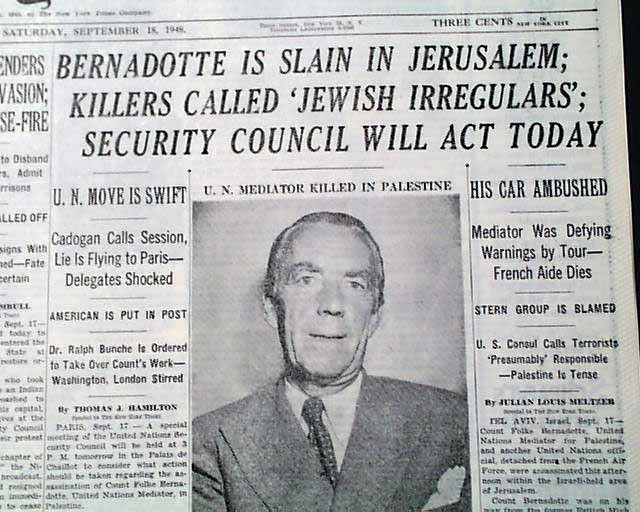
Bernadotte assassination newspaper report
This plan did confirm the existence of the State of Israel, but also strongly supported the Palestinian right of return. It advocated that the Palestinians who had been expelled from their land and possessions during the “Nakba” — the Catastrophe — be allowed to return and reclaim them.
For those who did not return, repatriation, resettlement, and financial compensation were envisioned. The Zionists, however, could not accept this. They aspired to an ethnically cleansed “Eretz Israel.”
Yitzhak Shamir, leader of the “Lehi” at the time of Bernadotte’s assassination and significantly involved in the notorious Deir Yassin massacre, in which more than 100 Palestinian civilians were killed, was an influential figure in Israeli politics for many years and served as both Foreign Minister and Prime Minister. His figurine is available as a souvenir in the Eretz Israel Museum, as is that of Vladimir Jabotinsky, perhaps the most influential Zionist ideologue.
Jabotinsky, founder and leader of the Revisionists, is a good example of the fascination that Italian fascism held for the Zionist founding thinkers. A central component of Mussolini’s master plan for a new Italy was a grand educational project for the people: physical fitness combined with the transformation of consciousness, education for combat, and the acceptance of danger. The male ideal was embodied in the figure of the warrior, the legionnaire.
Here is a quote from the introduction written by Jabotinsky to “Chaim Nachman Bialik: Poems from the Hebrew”: “The (Jewish) Ghetto despised physical manhood, the principle of male power as it was understood and worshipped by all free men in history.”
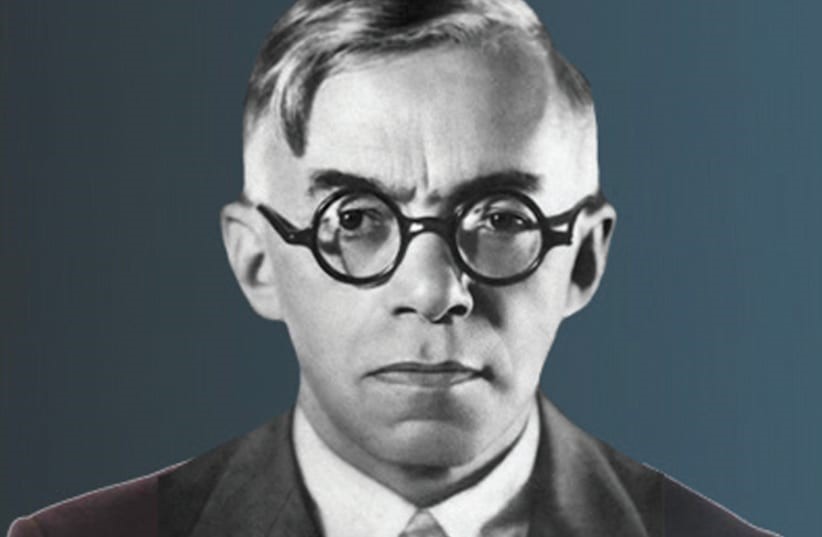
Yaakov Shapiro summarizes the Zionist enthusiasm for power and violence as follows: “They looked down on the Jews as ‘stooped, ragged, depressed figures who put all their trust in the Psalms of David ben Yishai.’ At the same time, they admired the big, muscular, sun-tanned Russian Cossack, whose entire faith lay in his ability to shoot, or the blond, blue-eyed German Aryan, in whom they saw the qualities of beauty, strength, and honor.”
Antisemitism as a Symptom
But even more than beauty, strength, and honor, they saw in the non-Jewish people and their behavior forms of normality. The cultivated, honorable German intellectual, the strong, courageous Russian Cossack — that is what a human being should be, they believed. That was normal. The Jews, on the other hand, were abnormal, sickly, psychologically damaged, and broken people.
From Shapiro’s perspective, the genesis of the Zionist ideology presents itself as follows: “The Zionists created Zionism to do far more than simply respond to antisemitism. The existence of antisemitism led the Zionists to the conviction that something was wrong with the Jews, that something needed to be ‘fixed’.
Like a doctor who recognizes pain as a symptom of a disease, the Zionists believed that the existence of antisemitism was a symptom that something was wrong with the Jew.”
Shapiro supports this thesis with, among other things, a further statement by Jabotinsky: “I have no doubt that I am a Zionist, because the Jewish people are a very nasty people, and their neighbors hate them, and they are right.”
The project of creating the new Zionist human being found its linguistic expression in modern Hebrew. Yakov Rabkin, Professor Emeritus of History at the University of Montreal, writes in the 2010 article “Language in Nationalism: Modern Hebrew in the Zionist Project”: “Jewish self-hatred is an essential component of Zionist ideology. In this case, it is expressed as ‘negation of the Diaspora’ and in its vernacular language, Yiddish. The word ‘Hebrew’ became synonymous with ‘new’ and ‘pioneer’ in the vocabulary of the Zionists. The new nation was to be Hebrew, not Jewish, and to live in Hebrew villages, far from the Jewish ‘shtetls’ of Eastern Europe, where most Zionist pioneers had been born and raised. Since the early twentieth century, modern Hebrew, the new common language, has been shaping the new Hebrew human being, a counterpart to the Diaspora Jew. The proponents of the new vernacular gave traditional Jewish concepts a new, secular meaning. Thus, it came about that the word ‘bitahon,’ which means ‘trust in God,’ took on the meaning of ‘military security.’” ¹¹
On Jabotinsky’s Wikipedia page, the following quote from him can be found: “In order to imagine what a real Hebrew is, to form a picture of him, we have no example to orient ourselves by. Instead, we must apply the method of ipcha mistavra (Aramaic for deriving something from its opposite): We take as our starting point the Yid (used here as a pejorative word for Jew) of today and try to imagine his exact opposite.
The Hebrew should be proud and independent
Let us erase from this image all personality traits that are so typical of a Yid and let us insert all desirable qualities whose absence is so typical of him. Because the Jew is ugly, sickly, and unsightly, we will equip the ideal image of the Hebrew with masculine beauty, stature, massive shoulders, vigorous movements, radiant colors, and shades of color.
The Jew is fearful and oppressed; the Hebrew should be proud and independent. The Yid is repugnant to everyone; the Hebrew should enchant everyone. The Yid has accepted submission; the Hebrew should know how to command. The Yid likes to hide with bated breath from the eyes of strangers; the Hebrew should march with brazenness and grandeur before the whole world, look it directly and deeply in the eyes, and raise his banner: ‘I am a Hebrew!’” ¹²
I left the “Eretz Israel” Museum and made my way to my next stop, the “Palmach” Museum. The “Palmach” was a special unit of the Haganah, the largest Zionist militia, from which the Israeli army emerged. The museum is located only a few hundred meters along the same street, Chaim Levanon Street.
At the museum reception, I learned that the “Palmach” Museum can only be visited with a guided tour. Without understanding why, I accepted the appointment suggestion for the next day at 9:30, returned to the hotel, and spent the rest of the evening doing research.
The Dream of the Iron Wall
Vladimir “Zev” Jabotinsky is an interesting, ambivalent figure. In Israel, 57 streets, parks, and squares are named after him, more than after any other person in Israeli history. He was a soldier, translator, author, and founding thinker of Zionism. Despite his aversion to the “Yid”, he urgently warned Eastern European Jews of an impending catastrophe and tried to persuade them to emigrate to Palestine. He died in 1940 and thus did not live to see the founding of the State of Israel.
Jabotinsky harbored no illusions about the Zionist project and was a friend of plain language. In 1925, he wrote: “If you intend to colonize a land in which people already live, you need an occupying force or a benefactor who provides the occupying force. Zionism is a colonial project, and for this reason, the question of troops is the decisive issue.”
Jabotinsky’s view of the Palestinians seemed, at least, not as clouded by racism and arrogance as was common at the time. In 1923, the newspaper Haaretz published an article by him in which he assessed the situation as follows: “(Zionist) settlement can only develop under the protection of a force independent of the local population, behind an IRON WALL that they cannot breach. A voluntary agreement is simply not possible. As long as the Arabs preserve a glimmer of hope that they will succeed in getting rid of us, nothing in the world can cause them to give up this hope, precisely because they are not rubble, but a living people. And a living people will only be prepared to yield on such fateful questions when it gives up hope of getting rid of the foreign settlers.”
Elsewhere, Jabotinsky writes: “The Arabs loved their land just as much as the Jews. Instinctively, they understood Zionist aspirations very well, and their decision to resist them was only natural. There was no misunderstanding between Jews and Arabs, but a natural conflict.” With this attitude, he stands in pleasant contrast to another literary-minded folk hero of the colonial era, his contemporary Winston Churchill.
The Dog in the Kennel
Churchill’s conviction regarding the superiority of the white race was unambiguous and probably represents the consensus of his time more accurately. The Nobel Prize winner in Literature put his position succinctly: “I do not admit that the dog in the kennel has the right to the kennel, even though he may have lain there for a very long time. I do not admit that right. I do not admit, for instance, that a great wrong has been done to the Red Indians of America or the black people of Australia.
I do not admit that a wrong has been done to these people by the fact that a stronger race, a higher-grade race, or at any rate a more worldly-wise race, to put it that way, has come in and taken their place. I do not admit it. I do not think the Red Indians had any right to say: ‘The American continent belongs to us, and we do not want these European settlers to come here.’ They had neither the right nor the power.” ¹³
Churchill’s comments on the Arabs are also concise and unmistakable: “Churchill described the Arabs as a ‘lower manifestation’ than the Jews, whom he regarded as a ‘higher-grade race’ compared to the ‘great hordes of Islam,’ and called the Palestinians ‘barbaric hordes who eat nothing but camel dung.’” ¹⁴
Even if the racist attitude of the Zionist founding thinkers was perhaps not as clearly pronounced and formulated as that of the multi-talented Churchill, there is no question that racism and racial arrogance were a necessary prerequisite for the Zionist colonial project in Palestine.
The conviction of the superiority of one’s own — that is, the white race prepared the ground for the systematic dehumanization of the Palestinians. The American anthropologist David Livingston writes in his book Making Monsters: The Uncanny Power of Dehumanization: “The dehumanization of a group is typically preceded by its racialization.”
Barbarism Against Civilization
“Europe would benefit from a modern Jewish state on the border with Asia, serving as an outpost of culture against barbarism.” Theodor Herzl’s remark in his otherwise rather pragmatic and practice-oriented blueprint for the “Jewish State” testifies to the racial arrogance that was, at the end of the nineteenth century, unquestioned convention. While the explicit belief in the superiority of the white race as the representative of culture, the conqueror and educator of inferior races, has since been tabooed worldwide, it appears to live on in the political elite of Israel and large parts of the Israeli population.
In his speech before the American Congress on July 24, 2024, Benjamin Netanyahu again described the confrontation with the Palestinian resistance in these words: “This is not a clash of civilizations. It is a clash between barbarism and civilization.” Netanyahu’s speech, an impressive example of cynical, shameless propaganda, was met with 58 standing ovations. ¹⁵

I wrote this essay because I am horrified that the German government has supported the massacre in Gaza. As a German citizen, I am disgusted by the misuse of Holocaust remembrance to support a genocide.