
Tamir picks me up at 9 AM. He says it’s a good time to get through the checkpoint quickly. Later, I read in a travel blog that it is apparently forbidden to take a taxi from Israel into the West Bank. You are only allowed to take the Israeli taxi to the border and must then switch to a local taxi. Fortunately, I did not know this at the time of our crossing. I was already uneasy at the thought of the checkpoints even without this knowledge, although I don’t expect to run into trouble.
A German tourist on his way to Bethlehem seems innocent enough and will probably be waved through. It is the Palestinians who have to suffer at the checkpoints. Rashid Khalidi, the former professor at Columbia University in New York, describes the role of checkpoints in the lives of Palestinians as follows: “The quintessence of the Palestinian experience takes place at a border, an airport, a checkpoint: in short, at one of those many modern barriers where identities are checked and verified. For Palestinians, the encounter with these barriers means the experience of powerlessness and fear.”
Particularly feared is Checkpoint 300, the most frequently used checkpoint between Jerusalem and the southern West Bank. Checkpoint 300 presents a dystopian panorama: a nine-meter-high concrete wall, watchtowers with darkened glass windows, machine-gun muzzles peering through firing slits, the whole adorned with anti-apartheid Banksy street art.
The Palestinian author Ahmed Alkhateeb described his experience with Checkpoint 300 in a 2020 article for Haaretz: “Each room has a cage-like turnstile with a very small opening through which only one person can fit. On the other side of each turnstile is a metal detector next to a small room with a darkened glass window. The Israeli soldier in the control room operates the turnstiles remotely.
An electric display on top of the turnstile lights up green when it is open and red when it is closed. Usually, it would light up green for a few seconds and then stay red for minutes.” The waiting time at Checkpoint 300 can be hours. ⁴¹
Tamir and I passed through the “Tunnels” checkpoint this morning. It extends over four lanes in the direction of Jerusalem and two lanes in the direction of Bethlehem. Unlike Checkpoint 300, “Tunnels” is a “low-tech” checkpoint. Apart from the cameras, there are no visible machines — there isn’t even a traffic light to keep cars from driving up to the control points.
The only mechanisms used to slow cars down are speed bumps and the soldiers standing on the road when entering Israel. My nervousness proves unfounded; there are no soldiers on the lane heading toward Bethlehem — we are waved through without issue by the uniformed man in the guardhouse.
The “Tunnels” checkpoint is located several kilometers west of the “Green Line” in the West Bank. The “Green Line” is the armistice line between Israel and the West Bank, the Gaza Strip, the Golan Heights, and the Sinai Peninsula. In 1967, it became the dividing line between Israel and the territories it had conquered in the Six-Day War.
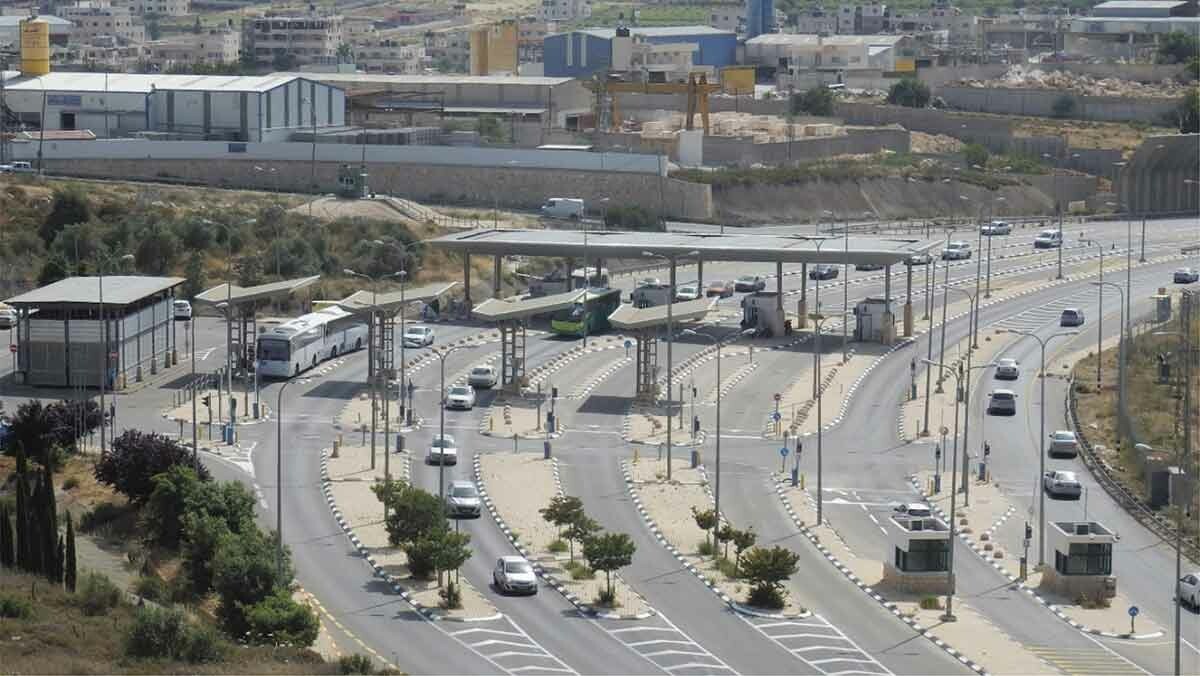
Tunnels Checkpoint
According to an NGO, as of June 2020, there were 179 checkpoints throughout the occupied West Bank, along with 154 road gates and 68 roadblocks. In addition, the Israeli army erects thousands of temporary checkpoints, so-called “flying checkpoints,” on the roads in the West Bank every year.
Under the Oslo II Accord reached in 1995 between Israel and the PLO, the occupied territories were divided into three categories. “Area A,” 18% of the total area, is under Palestinian Authority (PA) administration. Although the PA has control, Israel reserves the right to intervene militarily in certain situations. Bethlehem is in “Area A.” “Area B,” 22%, consists of smaller towns under the control of Israeli police and military, with Palestinian civil administration. “Area C,” 60%, is under Israeli military administration and military law. Palestinians there receive no building permits.
The Failure of Oslo
The Christian “Kairos Solidarity Network” describes the situation created by this division as follows: “Without the territories under Israeli administration, a viable Palestinian state is not possible. The livelihood of the Palestinians is being destroyed through land theft, the uprooting of more than one million olive and apricot trees, and the deprivation of water resources: Palestinians pay three times the price for water compared to Israelis and receive only 1/5 of the quantity, even though the water often comes from the West Bank.” ⁴²
The different perceptions of the Oslo Accords on the Israeli and Palestinian sides are another example of the ever-present danger with this topic: getting lost in side theaters and losing sight of the decisive factors. On the Oslo Accords alone, a whole series of books has been written.
Both sides are deeply dissatisfied with the outcome: the Israelis because Hamas, which disagreed with the conclusion of the agreements, hit Israel with a wave of attacks; the Palestinians because a sovereign state of their own, contrary to the promises made, has receded even further into the distance and they must continue to live under the boot of the Israeli occupation, whose control has in many areas even intensified. The Israeli historian Arnon Degani, who describes himself as a Zionist, has published an interesting English-language podcast on the topic. ⁴³
It is important to remain aware of the fundamental constellation: This is not a conflict between two parties that are even remotely on equal footing. It is not about Jews and Muslims who have been bashing each other’s heads in down there for millennia. It is about colonization and resistance, about oppression and self-determination.
The US government estimates the total Palestinian population of the West Bank at approximately 3 million people. According to UNRWA, the “United Nations Relief and Works Agency for Palestine Refugees in the Near East,” more than 912,879 registered refugees live in the West Bank, approximately one quarter of them in 19 refugee camps. Most of them are descendants of those expelled during the 1948 “Nakba.”
The Disinterest of the Media
Overcrowding in the camps is the norm; large families live in cramped, stuffy quarters, often without sanitary facilities. Access to clean water is a constant problem; power supply is irregular; and sewage systems are inadequate.
Another problem is the lack of access to education and professional opportunities. Unemployment and poverty prevail; many children are malnourished. The situation in Gaza is even more depressing, especially since the beginning of the Israeli blockade in 2007. These are living conditions that many Germans can barely imagine and that are hardly reported on in the German media.
The same applies to most Israeli media, with a few commendable exceptions, such as Haaretz journalists Amira Hass and Gideon Levy and the magazine +972. Israel is unique among democracies in that permanent military censorship exists. It is legally required that every article on security matters must first be submitted to the censor.
When Palestinians in the camps are reported on, it is usually about terrorists and Islamic Jew-haters; there is hardly any personal contact between the two groups. Many Israelis set foot in the house of a Palestinian family in Gaza or the West Bank for the first time when, as soldiers during a nighttime commando operation, they kick in the door.
Palestinians in the West Bank are considered stateless, as they do not possess citizenship in a recognized state. The PA does issue identity cards and passports, but these documents do not confer full citizenship rights and are not universally recognized. Israel retains control over the population registry in the West Bank, further complicating the legal status of the Palestinians.
The Israeli authorities severely restrict family reunification between Palestinians in the West Bank and their spouses living in Israel. The Israeli Citizenship Law prohibits family reunification for Palestinians, meaning that Palestinians from the West Bank who are married to Israeli citizens cannot obtain Israeli citizenship.
First-Class Citizens
As of early 2024, approximately 520,000 Jewish Israelis lived in settlements in the West Bank. The settlers are first-class Israeli citizens and enjoy all the privileges that come with it. Since the Palestinians in the West Bank do not possess recognized citizenship, they enjoy little legal protection. They are subject to military orders and laws that differ significantly from those governing the settlers. ⁴⁴
The continuous expansion of the settlements has made the creation of a contiguous Palestinian state impossible. Even though German politicians, such as Foreign Minister Baerbock, still speak of “the two-state solution being the only solution,” experts on the situation such as Ilan Pappé and Rashid Khalidi unanimously state that there is no longer any possibility of implementing a two-state solution, even if a government were to come to power in Israel that, unlike Likud, were actually interested in it.
After more than 50 years of occupation, a complex occupation architecture has developed in the West Bank whose goal is to separate the presence of the Palestinians living in the West Bank from the everyday life of the Jewish settlers. Nothing makes this clearer than the separation wall erected by Israel. The separation wall consists of concrete, barbed-wire-lined fences, and surveillance towers.
The wall, stretching over 700 kilometers, often stands far from the Green Line, deep in Palestinian land. Officially, it serves security purposes and is meant to prevent attacks. But its course has far-reaching effects on the lives of the Palestinian population; the wall severs not only geographical but also human connections. The barrier separates cities and villages, divides plantations, and makes access to education and medical care difficult for many Palestinians.
Forbidden Roads
Many of the roads that the Israeli state has built or renovated in the West Bank since the beginning of the occupation are also reserved exclusively for Israeli settlers. The system is so complex and confusing that the 2004 report “Forbidden Roads” by the Israeli human rights organization B’Tselem spans more than 50 pages. ⁴⁵
According to the report, the “regime of forbidden roads,” based on the principle of separation through discrimination, bears striking similarities to the racist apartheid regime that existed in South Africa until 1994. In the road regime operated by Israel, a person’s right to move within the West Bank is based on their national identity.
The Israeli state justifies the establishment of the regime of forbidden roads with the protection of the Israeli civilian population. During the second “Intifada,” the last major armed uprising of the Palestinians from the occupied territories before October 7, 2023, according to B’Tselem, 741 Israeli civilians were killed within 10 years, including 124 minors.
Although B’Tselem expressly supports Israel’s right to protect its civilian population, the report reaches an unambiguous verdict regarding the regime of forbidden roads: “The regime of forbidden roads is based on the premise that all Palestinians constitute a security risk and that it is therefore justified to restrict their freedom of movement. This is a racist premise that has led to a policy that indiscriminately harms the entire Palestinian population and violates their human rights as well as international law.”
The Camps of Bethlehem
In the Bethlehem area, there are three refugee camps. The “Dheisheh” camp, founded in 1949, houses over 8,800 residents on an area of 1.5 square kilometers. “Aida Camp” was established in 1950 and has approximately 2,800 residents. The “Beit Jibrin” camp is part of the municipality of Bethlehem and is the smallest refugee camp in the West Bank. It is also one of the most densely populated camps. The camp has one main road, approximately 250 meters long, that runs through the entire camp.
The children of the “Beit Jibrin” and “Aida” camps attend the same schools — the co-educational school in the town of Beit Jala and the boys’ school in the “Aida” camp. To reach the “Aida Boys’ School,” the students must cross a main road near the wall and an Israeli watchtower. Clashes frequently occur in this area, and according to a UNRWA report, tear gas canisters and bullets are repeatedly found in the schoolyard. ⁴⁶
On the way to Bethlehem, Tamir points out to me one of the yellow metal road gates with which the Israeli army can seal off access to towns and villages at will. “They block the streets whenever they want,” he says. “The Israelis are in control, not the PA.” His laconic remark mirrors the description that Rashid Khalidi gives of the situation: “The PA has no sovereignty, no jurisdiction, and no authority except that which is granted to it by Israel. Israel even controls a large share of the revenues through tariffs and other taxes.
The main task of the PA, for which a large part of its budget is spent, is the preservation of security — but not that of the Palestinian people: The PA is charged by the USA and Israel with ensuring security for Israel’s settlers and occupation forces against resistance, violent and otherwise.
Since 1967, there has been only one state authority in the entire territory of Mandate Palestine: that of Israel. The establishment of the PA has not changed this reality but has only rearranged the deck chairs on the Palestinian Titanic and provided the Israeli colonization and occupation with an indispensable Palestinian shield.” ⁴⁷
I would like to ask many questions — about the increasingly cruel behavior of the settlers since October 7th and the forbidden roads, for example — but I don’t feel comfortable doing so. The Gaza Strip is only 73 kilometers from Bethlehem. The airstrikes on Gaza continue; entire city blocks are razed to the ground; every day, whole families are wiped out; even tent camps are shelled.
There Is No Shortage of Information
There is hunger; there is barely any drinking water, barely any medicine, barely any electricity. In light of the monstrous crime happening less than 100 kilometers from us, my research seems tasteless, like a silly attempt to cling to the illusion that reporting can accomplish something. There is no shortage of information; there is a shortage of will among the powerful to do something.
It is obvious that I am not the first person Tamir has driven on a research trip through East Jerusalem and the West Bank. He already tells me, unprompted, what the others wanted to know too. His tone is not unfriendly, but flat and melancholic. I can understand him. He doesn’t want to give up hope, but generations of journalists have already reported on the situation of the Palestinians; the reports of the human rights organizations and the United Nations are unambiguous and run to thousands of pages.
In 2021, UN Secretary-General António Guterres said: “If there is a hell on earth, it is the lives of children in Gaza.” He was expressing his “deep shock” at the Israeli airstrikes and artillery attacks in Gaza at the time, which had cost the lives of more than 200 Palestinians, including 60 children, and injured thousands more. ⁴⁸
The then Israeli Prime Minister Naftali Bennett was indifferent to Guterres’s shock, just as today the world is indifferent to Benjamin Netanyahu’s horror.
“Refugeeland”
I think of a phrase by the American journalist Joe Sacco, who processed his time in the occupied territories in the early 1990s in a kind of documentary graphic novel. “Refugeeland.” That was the title Sacco gave to the account of his first visit to a refugee camp in the Gaza Strip.
At that time, the Gaza Strip was not yet completely cut off from the outside world. This phase, which made nearly half the population unemployed and led to 80% of the more than 2 million people becoming dependent on aid deliveries, began in 2007 with Hamas’s election victory.
Sacco writes in the cool, ironic style that was so popular in the 1990s: “Some of the blackest holes in the world are out in the open, and anyone can see them. You can, for instance, book a tour of a Palestinian refugee camp in the Gaza Strip. Just call UNRWA, the United Nations Relief and Works Agency, at 051-861195. They’ll take care of it, they’ll drive you, and admission is free. They’ll probably want to stick you in a group with Swedes and Japanese, but you want your refugee camp experience to be more intimate, and you insist on taking the tour alone.”
“Refugeeland.” A phrase that feels inappropriate 30 years later, even though Sacco mocks the absurdity of an excursion to a refugee camp, and his account of the situation honors the humanity of the Palestinians. Irony implies distance, and in 2024, it is hard to keep the horror at a distance. In 2024, the whole world can see the images of the carnage on their phones, and anyone who has not yet decided to block out everything negative and retreat into a “positive-vibes-only dreamworld” is condemned to a feeling of powerlessness, of impotent moral disgust.
Wounded Child No Surviving Family
Hospitals in Gaza were forced to introduce a new abbreviation: “WCNSF” — Wounded Child No Surviving Family. Injured children are operated on without anesthetics due to the blockade; stray dogs tear pieces from unburied corpses; the stench of untreated sewage and decomposing bodies under the rubble hangs in the air. “Refugeeland” has become “Genocideland,” and the irony-loving 1990s seem like a better, more innocent time. 2024 is a year about which schoolchildren will ask: “And why did nobody do anything back then?” when they cover it in history class.
We arrive in Bethlehem, park near a PA police station, and walk across Manger Square toward the Church of the Nativity. The streets of the old town around the Church of the Nativity are narrow and uneven. The low stone buildings with their arched doors and barred windows stand close together, but Manger Square is a spacious plaza paved with light limestone.
Christians in Palestine
On the western side stands the Omar Mosque, the only mosque in the old town. Opposite, on the eastern side, towers the Church of the Nativity, a stoic witness to a long and eventful history. The morning sun is shining, and the massive limestone walls of the church glow in warm earth tones. The simple bell tower rises like an index finger into the sky. It is a massive, rugged structure, a fortress-like basilica.
It has survived invasions, regime changes, fires, earthquakes, and most recently the siege by Israeli troops in 2002. In 1852, the church was placed under the joint custody of the Roman Catholic, Armenian, and Greek Orthodox churches.
The basilica is surrounded by three monasteries, each representing one of these faiths: the Franciscan Monastery and the Church of St.Catherine on the northeast side, the Armenian Monastery, and the Greek Orthodox Monastery on the southeast side.
We enter the church through the “Door of Humility,” a small rectangular entrance from the Ottoman period. The doorway was reduced in size to prevent looters on horseback from entering and plundering the church. Entering the wide nave transports you fifteen centuries back in time, especially this morning, for the first five minutes, we are the only visitors. The nave is supported by four rows of columns made of pink limestone; many columns are decorated with paintings, though what exactly is depicted is hard to make out in the dim light.
Even though I chose Bethlehem as a destination in the West Bank primarily because it seemed harmless and innocuous, I cannot resist the awe-inspiring effect of the nave. I resist it internally, because the awe-inspiring architecture of sacred buildings is also a form of intimidation, of manipulation. It exploits the human need for self-transcendence and loss of self for the benefit of an institution, and institutions are demonic, as the theologian Paul Tillich writes.
Believers Who Pray with Bloody Hands
All religious institutions are suspect, but the monotheistic ones are the most dangerous. Yahweh is a jealous God: “You shall have no other gods before me” is his first commandment. Monotheisms are the substrate on which the illusion of dividing humanity into the good and the evil thrives best; the illusion of fighting on the side of the absolutely good against the absolutely evil is perhaps the most effective justification for war and violence.
Nevertheless, all holy books contain beautiful, ethically elevated passages — for example, in the Quran: “O mankind! We have made you into nations and tribes so that you may know one another. The noblest of you in the sight of God is the most righteous among you.”
In Judaism, it is tradition to read from the “Haftarah,” the Book of Isaiah, on the Sabbath and holidays: “When you spread out your hands, I will hide my eyes from you. Even though you make many prayers, I will not listen. Your hands are full of blood. Wash yourselves, make yourselves clean! Remove the evil of your deeds from before my eyes! Cease to do evil! Learn to do good! Seek justice! Help the oppressed! Defend the orphan! Plead for the widow!”
Repulsive are the believers who pray with bloody hands, who focus on the aesthetic and formal aspects of religion, ignore the ethical core of the message, and misunderstand religious symbols as tribal emblems. Unfortunately, this superficial form of piety is widespread. I wonder what the believers think when they pass through the checkpoints and drive past the wall and the refugee camps.
Do they think of the Gospels? Do they think about the fact that the Lord sent his son “to proclaim the Gospel to the poor, freedom to the captives and sight to the blind, to set the oppressed free”? What does visiting the birthplace of Jesus mean to them? How do they follow in the footsteps of Christ?
The Little Sisters of Jesus
An Asian woman with a selfie stick slips through the Door of Humility — the first of a group of Asian Christians. The reverent five minutes in the Church of the Nativity are over. Only afterward do I realize what a privilege it was to experience the church so empty. In a normal year, Bethlehem receives 1.5 million visitors. At the time of our visit, the city seemed deserted.
To my surprise, Bassem, an acquaintance of Tamir’s, approaches us and greets us. He is older than Tamir, has a receding hairline, and wears a mighty mustache. I estimate he is in his mid-50s. Bassem speaks good English and gives us a tour of the church. He shows me the various areas reserved for the three religions and the entrance to the Grotto of the Nativity, where a ceremony is taking place at the time of our visit.
At first, I am not clear about the reason for his presence, but it doesn’t take long for the puzzle to be solved. He invites us to coffee at his shop, which is just a few hundred meters from the Church of the Nativity. Hardly any tourists come to Bethlehem; Tamir had obviously tipped him off, hoping I would generate some business.
On the way to his religious souvenir shop, we pass a sign that catches my attention: “The Little Sisters of Jesus.” I take a photo of the sign, assuming it is the shop’s original name. I had been under the impression that, because of his divine fatherhood, Jesus was an only child. (Back at the hotel, I Google the name and it turns out that the “Little Sisters” are a Catholic religious order that traces itself not to Jesus Christ but to the French monk and hermit Charles de Jésus.)
No Pilgrims in the Holy Land
Once in the shop, Bassem insists that we first drink the promised coffee together. On the walls of his shop stand shelves made of darkly stained wood. On one of them, arranged in rows by size, stand olive wood carvings: crosses, nativity scenes, and statues of saints. But it is the Orthodox icons that dominate the room. Their aesthetic reminds me of the figures in the chapel of my hotel. Their surfaces, decorated with gold leaf, reflect the light, while the painted figures stare at the viewer from their elongated, serious faces.
Bassem brings the coffee. We sit on a bench in front of the shop and talk about the difficult situation in which the Palestinian Christians in Bethlehem find themselves. Many of them, like him, make their living from tourism, but since October 7th and the beginning of the Israeli retaliatory campaign, hardly any tourists come to Bethlehem. The birthplace of the Palestinian Jew Jesus of Nazareth was once home to a large Christian community.
According to UN information, in December 1946, 145,000 Christians lived in the land, accounting for 12% of the total Palestinian-Arab population. During the “Nakba” of 1948, 75,000 Palestinian Christians were driven from their homes and became refugees in neighboring countries as well as in the West Bank and the Gaza Strip. Today, approximately 45,000 Christians live in the West Bank, while only about 1,000 remain in Gaza.
Palestinian Christians have always posed a problem for the Zionist propaganda narrative of antisemitic Islamofascists, because Palestinian Christians have also been at the forefront of the armed resistance against the Zionist colonial project. Particularly prominent examples of militant resistance from the Christian population of Palestine are George Habash and Wadie Haddad. Both men were born as Greek Orthodox Christians and driven from their homeland.
From Doctor to Terrorist
They met during their medical studies in Beirut and initially worked as doctors in the then-newly established refugee camps. Afterward, they became involved in the resistance and, in the late 1960s, founded the still-existing Marxist-Leninist group “Popular Front for the Liberation of Palestine” (PFLP).
The career paths of these two men make clear how incidental ideological and religious labels are to the actual motivation of the actors. Habash and Haddad were motivated neither by the Christian faith nor by revolutionary Marxism, just as today the fighters of the “al-Qassam Brigades” are not motivated by Islam.
So what turned Habash, the Christian doctor, into a violence-ready revolutionary? A journalist for the then still-relevant Time magazine, not suspected of any sympathy for the Palestinian resistance, once asked Habash, who died in 2008, exactly this question. The account by Time journalist Scott MacLeod is illuminating. In response to MacLeod’s question about his motivation, Habash simply told him about his personal experiences when his family lost their home during the 1948 war:
“His mother insisted that he stay in Lebanon for his studies. When war broke out in 1948, he returned to Lydda. In July, Israeli troops under the command of Moshe Dayan marched into Lydda. In Israeli accounts, the Palestinians were long depicted as having ‘fled.’ However, the Israeli historian Benny Morris wrote in 1999 that Israeli forces had killed at least 250 townspeople, including young men who were massacred in a mosque.
No More Time for God
It was the horror that Habash also remembered, made worse by a personal tragedy: that same night, one of his sisters died. Although she died of typhus, the clan blamed the Israeli attack for preventing her from receiving proper care. He buried his sister in the backyard, took her small children by the hand, and followed the instructions of the Israeli soldiers to leave the city. ‘The soldiers said: “Everyone out! In that direction!” I remember asking one of the soldiers where we were supposed to go.’ Habash told me that he rejected Christianity at that point. ‘I kept imagining myself as a good Christian serving the poor. When my country was occupied, I had no time to think about religion.’”
Habash never returned to Lydda, which was renamed Lod and became part of the State of Israel.” ⁴⁹
It was obviously not necessary to teach Habash hatred of the Israelis, and he did not take up arms because he read Marx and Lenin. How many of the thousands of young Palestinians who are currently having similar experiences in Gaza will choose the armed struggle?
The PFLP pioneered the hijacking of airplanes as a terrorist tactic in the Middle East as early as 1968, when three armed PFLP agents hijacked an Israeli El Al flight on its way from Rome to Tel Aviv. Since then, checking in for a flight has never been the same.
Unlike Hamas, the PFLP at that time was actually a globally operating group that used terrorist means to achieve its political goals. In 1970, PFLP members hijacked four planes simultaneously, flew three of them to Jordan, blew them up, and thereby triggered a war between the Jordanian monarchy and the Palestinian guerrillas.
In Germany, it is above all the hijacking of the Lufthansa flight “Landshut” by the “PFLP-SC” — a splinter group of the organization founded by Habash and Haddad — that remains in memory. The hijackers demanded the release of eleven first-generation RAF terrorists imprisoned in West Germany, including Andreas Baader, Gudrun Ensslin, Jan-Carl Raspe, and Irmgard Möller.
PFLP Meets RAF
In addition, the commando wanted to free two Palestinians from Turkish prisons; as ransom, the hijackers also demanded 15 million US dollars. The five-day drama ended in October 1977 with the storming of the aircraft in Mogadishu by a special unit of the German Federal Police, the famous GSG-9. The failed operation was presumably the trigger for the suicides of the RAF leadership figures in Stammheim prison.
In a paper from the “INSS,” the Institute for National Security Studies, a think tank at Tel Aviv University, Haddad is quoted with the following description of the PFLP’s strategy:
“I mean spectacular, one-off actions. These spectacular operations will draw the world’s attention to the Palestinian issue. The world will ask: ‘What the hell is the problem in Palestine? Who are these Palestinians? Why are they doing these things?’ At the same time, such operations will be very painful for the Israelis. Spectacular, sensational operations, carried out by well-trained people in secure secret structures — that is how we will hit them where it hurts. In the end, the world will be fed up with its problem; it will decide that it has to do something for Palestine. It will have to give us justice.” ⁵⁰
So far, the world has not given the Palestinians justice. Wadie Haddad died in 1978 in terrible pain in an East Berlin hospital. By all appearances, the Israeli intelligence service Mossad murdered him with poisoned toothpaste. ⁵¹
George Habash died in 2008 in the Jordanian city of Amman from a heart attack. As’ad AbuKhalil, Professor of Political Science at California State University, described his reaction to the news in an article for the blog of the International Solidarity Movement:
“I have spent more than half my life in the United States and never felt the sense of alienation I experienced on the day I read in a front-page obituary in the New York Times that George Habash, the Palestinian revolutionary who died last week, was described as a ‘terrorism tactician.’ What do you do when someone wants to convince you that a kind and gentle man you have come to know and respect as a person is a terrorist, even though you know better? Do you argue in vain about definitions?
Do you go back and see how the Times wrote glowing obituaries for the Zionist militia leader and later Israeli Prime Minister Yitzhak Rabin, a man whose record of killing civilians is just as terrible and grotesque as that of Osama Bin Laden, former Israeli Prime Minister Menachem Begin, the founder of the Fatah Revolutionary Council Abu Nidal, or the Chilean dictator Augusto Pinochet?” ⁵²
Habash and Haddad saw armed struggle as the only way to achieve their political goals — a view they shared with Yitzhak Rabin, Menachem Begin, and David Ben-Gurion. Alongside this, however, there is also a long tradition of nonviolent Palestinian resistance. The last major wave of nonviolent resistance was the “Great Marches of Return” demonstrations.
The “Great Marches of Return” began on March 30, 2018, to demand the end of the Israeli blockade and the right of return for refugees of the “Nakba” and their descendants. The IDF responded to the largely peaceful demonstrations with extreme violence and targeted killings by snipers. Among those killed were children, paramedics, journalists, and people with disabilities. 183 people were shot dead, and another 6,106 were wounded with live ammunition. ⁵³
Munther Isaac, the pastor of the Evangelical Lutheran Church in Bethlehem, is a current example of this tradition of nonviolent Palestinian resistance. On February 18, 2024 — five days before my arrival in Israel — Isaac delivered a sermon at the Bloomsbury Central Church in England.
The Betrayal of the Brothers in Faith
He appealed to the conscience of his Christian brothers in faith and described the situation in Palestine in clear terms: “I address the churches in the United Kingdom: As churches that strive for justice and righteousness, we must, in obedience to Christ’s commandment, have the courage to speak our minds and call things by their names! This is not a conflict; Israel is not exercising its right to self-defense. Rather, Israel is the colonizer; Israel is a settler colony. We live under apartheid. What is happening in Gaza is a genocide and ethnic cleansing.” ⁵⁴
Isaac’s criticism of the lack of support for the Palestinian cause by Western Christians, especially Christians in the USA, seems justified. The organization “CUFI,” “Christians United For Israel,” founded by the American televangelist John Hagee, for example, claims to have more than ten million members. CUFI supports the illegal settlement of the West Bank and ignores the situation of Christians there. Hagee and CUFI are fanatical supporters of Israel, whose existence they see as the fulfillment of biblical prophecy and a sign of the imminent return of the Savior. ⁵⁵
The “Christian Zionists” support the annexation of the West Bank and a purely Jewish state because only in this way can the prophecy be fulfilled. The return of the Savior would, however, not be good news for the Jews who would dare to continue insisting on their Judaism, as the majority of them did during the Savior’s first visit to Earth. There is disagreement among the evangelicals as to what exactly would happen to these stubborn Jews, but the consensus seems to be that they would be judged and denied heaven. If there were a similar prophecy in Islam, it would certainly be called antisemitic.
The “Christian Zionists” are now the most important and most uncritical supporters of the Israeli government. Their number in the USA alone is estimated at 30 million; they are well-organized and possess significant political power. Netanyahu speaks at their conferences and invokes their covenant with Israel. The situation is almost unrivaled in its absurdity: While ultra-Orthodox Jews like Yaakov Shapiro reject the Israeli Zionists, accuse them of identity theft, and resist being identified with Israel, the atheistic Zionist elite around Netanyahu enters into an alliance with these ignorant fanatics — with fanatics who adhere to an antisemitic ideology.
Holy Earth for the Mother-in-Law
This kind of absurd entanglement and inconsistency is one of the reasons why I am suspicious of every form of organized religion and ideology. But Bassem and his souvenir shop have nothing to do with the abuse of Christian ideas — he wants to feed his family, and I am obviously the first customer in his shop in days.
I know that my mother-in-law will be pleased with Christian souvenirs straight from Bethlehem, and I engage in the sales conversation. He shows me a small icon with a gold-leaf border. The price he quotes me seems far too high, so we start haggling.
In the end, I bought the icon, a larger cross, and a small one packaged in a transparent bag with certified holy earth from Bethlehem. As a free bonus, Bassem throws in a necklace with a Star of David pendant. Once we are back in the car, Tamir praises me for having haggled. He says he would have intervened if I had accepted the first price. As we reach the “Tunnels” checkpoint, I get a small taste of how Palestinians experience encounters with Israeli soldiers.
The soldier standing on the road signals us to pull over into the side lane. When we come to a stop, he taps the barrel of his M16 against the driver’s side window. Tamir rolls down the window, and the soldier speaks to him in Hebrew. There is nothing of the superficial, mechanical politeness I am accustomed to from border officials in the young soldier’s manner. His tone is condescending; he dominates the situation in a casual, subtly threatening way.
Tamir answered him in Hebrew. I sit in the back seat; the soldier turns his attention to me — obviously, Tamir has explained to him what the occasion for the tour was. The soldier asks me to show him my passport and studies the visitor card I received at the airport. After that, he lets us continue. I ask Tamir what the “worst case scenario” of such an encounter at the checkpoint would be.
Strict Sabbath in Jerusalem
“They can arrest you. And they can keep you as long as they like,” he answers without hesitation. “They have a special name for it; I don’t know what it is called in English.” (Later, I find out he means “administrative detention”: “In administrative detention, a person is held without trial, without having committed an offense, on the grounds that they intend to break the law in the future. Since this measure is supposed to be preventive, it is not time-limited.”) ⁵⁶
I changed the subject and told Tamir that I had difficulty finding an open restaurant the evening before.
He replies that it would be even more difficult the next day because, unlike in Tel Aviv, in Jerusalem, the Sabbath is strictly observed. Most shops and restaurants close as early as Friday afternoon. I hadn’t thought of that and asked him whether it would even be possible to get a train to Tel Aviv on Saturday. “No, I don’t think so,” he answers.
I feel nervousness rising in me. My return flight from Tel Aviv to Amsterdam is very early Sunday morning; I had wanted to spend the last night in Tel Aviv. The prospect of everything in Jerusalem being closed the next day doesn’t appeal to me either. Before Tamir drops me off at the hotel, we agree that I will contact him later if I decide to leave Jerusalem that same day.
The Abolition of the Green Line
Back at the hotel, I answer emails and search for more information about the checkpoints. To my surprise, I find a scholarly article from 2021 that deals explicitly with the “Tunnels” checkpoint. The 25-page article, written by a Dutch geographer, reaches the following conclusion:
“The arbitrariness in deciding who is stopped and who is not — which for my interviewees also included the checking of commuters who cross these checkpoints daily — shows that the checkpoints are a tool for Israeli soldiers to reinforce the asymmetric relations between occupier and occupied.
As such, the checkpoints, through their spatial design, their layout, and their managers, generate specific geographies aimed at restricting and controlling the freedom of movement of Palestinians, while simultaneously advancing the continued abolition of the ‘Green Line’ and the future establishment of a ‘Greater Israel.’” ⁵⁷
I am still unsure whether I should spend another night in Jerusalem as planned. Tamir was right — on Saturday, the trains in Israel do not run. By now it is 1 PM; the last train to Tel Aviv departs in two hours. The Old City and the Western Wall have impressed me the most, and I want to pay them one more — perhaps the last — visit.
As I step out of the narrow alley at the end of which the hotel lies hidden behind a wall, I am presented with a scene that differs markedly from the previous days. The street is full of people — many of them Palestinians, in small groups, obviously headed for the Damascus Gate.
It is the time of Friday prayers; they are on their way to the Al-Aqsa Mosque. On the previous days, only a small group of Israeli soldiers stood at the fortified guardhouses at the Damascus Gate. On this day, there are many more, and they are already standing on the street well before the gate.
The Privilege of Being Ignored
The soldiers operate several “flying checkpoints,” randomly picking out passersby and demanding to see their papers. If the inspection of an individual takes longer, they order the others to keep moving. Their treatment of the Palestinians is disrespectful and aggressive; they don’t even try to conceal their contempt. They ignore me completely — never before have I been so acutely aware of the privilege of my white skin.
At the guardhouse before the Damascus Gate, there is also a larger number of soldiers today, who likewise ignore me. Inside the Old City, too, everything is different today: the soldiers are not standing behind metal barriers to the side, as on previous days. Today, the metal barriers stand in the middle of the alley and have become additional “flying checkpoints.”
Even though I have not been asked for my papers once so far, it occurs to me that I left my passport at the hotel. The narrow alley is now full of people; I can only advance slowly. I realize that I will miss the train if I continue.
I decide to leave Jerusalem and turn back. Once back near the hotel, I stand on the street for a few more minutes and observe the interactions at the “flying checkpoints.” The soldiers’ arrogance comes across as casual, but that makes it even more provocative and threatening.
It is obvious that the mood could tip at any moment. The dehumanization of the Palestinians, expressed in the soldiers’ behavior, is so obvious and unmistakable — I have never seen anything comparable. Hardly any of the Palestinians dare to get agitated, to argue; they know exactly what consequences await them.
Flight from Jerusalem
Back in the room, I write Tamir a message. I ask him to pick me up and begin packing my worn red cabin trolley. Tamir responds quickly but doesn’t have time and promises to send a friend to pick me up. Mohamed will be there in half an hour at the latest — enough time to catch the last train to Tel Aviv.
I use the waiting time to book two nights at a hotel in Tel Aviv online and to explain to the friendly receptionist with the blue horn-rimmed glasses why I am leaving the hotel a night early. I don’t want her to think there was something wrong with the room.
I have barely convinced her of my ignorance about the strict observance of the Sabbath in Jerusalem and my poor planning when I receive a message from Mohamed. He is waiting for me at the entrance to the alley. I say goodbye and make my way to him. Mohamed is older than Tamir, seems more sober, less fashionable.
His hair is cropped short, and he wears a plain black shirt. He speaks good English and tells me that he is studying engineering but is currently taking time off to earn money driving a taxi and support his family.
I tell him about the scene on the street. Mohamed is unimpressed. That was nothing, he says — he knows many people who have been arrested during such checks and disappeared for a long time. Since October 7th, everything has only become more extreme. I remember my reaction exactly because, in hindsight, it embarrasses me so much.
I ask him: “What can you do in such a situation? Just accept it?” “No, I don’t accept it,” he answers. His tone remains calm, but I sense the pain and the anger he is hiding.
What a stupid question. How would I feel in his situation? Like a second-class human being? Would I simply accept it? I apologize for my stupid question, and we have already arrived at the train station. He looks at me and says goodbye with a smile: “Don’t worry. It’s hard to imagine for someone who doesn’t live here. I understand. Have a safe trip.”
“We’re Fucking Them”
The last train to Tel Aviv is already at the platform but won’t depart for another 15 minutes. After buying my ticket at the machine and stowing my trolley on the train, I notice a small group of three soldiers, half hidden behind a pillar, smoking cigarettes. So far, I haven’t had the opportunity to get into conversation with Israeli soldiers. This seems like a good opportunity.
I get off the carriage again and walk over to them. They are young conscripts — one woman and two men. I take out a cigarette and ask for a light. After I have lit my cigarette, they signal me to come closer, to stand behind the pillar like them — smoking on the platform is forbidden. The spokesman, heavyset and with a three-day beard, asks where I’m from, and I answer truthfully. The young woman wants to know whether conscription is also in place in Germany. When I say no, she explains the Israeli system to me.
Suddenly, the heavyset one asks me what I think about the war in Gaza. I wasn’t expecting this, and the best I can manage is to say: “Well, it’s not a fair fight, is it?” The third, a lanky one wearing glasses who has been silent until now, looks at me thoughtfully and answers: “No, it isn’t.” The heavyset one puts his fists to his sides, thrusts his pelvis forward, and says: “We’re fucking them.”

I wrote this essay because I am horrified that the German government has supported the massacre in Gaza. As a German citizen, I am disgusted by the misuse of Holocaust remembrance to support a genocide.