I decide to take a break from the research. I know that the carnage in Gaza continues; later, I read that on this day, another 40 Palestinians were killed in the bombardment of a residential building. I feel exhausted and overwhelmed, stay in bed for a long time, answer emails and WhatsApp messages, and check whether I have a new match on “Bumble.”
“Bumble,” the dating app that is rather more wholesome compared to “Tinder” and geared toward serious intentions, seems to me a good way to get into conversation with Israelis. I have resolved not to mention the topic of genocide in Gaza in the chats. I want to understand how Israelis think about the subject when they don’t feel on the defensive — whether they even bring it up at all.
I chat with L., an educated-seeming woman in her 40s, who, after a brief initial small talk, asks me whether I am Jewish. It is obviously impossible to escape the topic for even an hour. I answer truthfully that I don’t know for certain, but there is a possibility that my maternal grandfather was Jewish.
It is the family’s unsolved mystery; the probability seems to favor it. From the perspective of Orthodox Judaism, this family relationship would not qualify me as a Jew. The “Halacha,” the religious law, stipulates that only someone born to a Jewish mother or who has undergone “Giur” — that is, converted before a “Beit Din,” a rabbinical court — is Jewish.
From the perspective of the State of Israel, the matter looks different: In 1970, the immigration guarantee of the Law of Return was extended to the children and grandchildren of a Jew. So, if my grandfather was indeed Jewish and never officially renounced his religious affiliation, I would have a chance of obtaining first-class Israeli citizenship.
Then I could, for example, live as a generously state-subsidized settler in the West Bank under the protection of the IDF, on expropriated or stolen land, and could use the roads reserved exclusively for Israeli citizens of Jewish nationality.
The Right to Mistreat with Impunity
I could have myself armed by the Israeli state and prevent Palestinian farmers from cultivating their olive groves, under the protection of the IDF, and in the hope that the farmers will give up, and we can reclaim another piece of “Eretz Israel.” This is how I could make my contribution to the realization of the Zionist dream, invoking the word of a God I don’t believe in, just like Ben-Gurion and Jabotinsky.
I would have the right to steal from and mistreat Palestinians with impunity. I would remain unpunished because I would be under the protection of the army, and as soon as anyone outside Israel dared to criticize me, I could play the victim and accuse my critics of antisemitism.
All of this I could do thanks to an absurd construct, a sleight of hand that has turned a world religion into a nationality. A nationality that defines itself through the proof of Jewish blood, but immediately renders the definition absurd by granting me first-class Israeli citizenship only if my grandfather was not a convert. Would his conversion to Christianity have had an effect on the Jewish proportion of his blood cells?
The Jewish Question
I ask L. to what extent it matters whether I am Jewish, and add that even if I were, it would seem unimportant to me, since I understand Judaism as a religion and I don’t believe in God. I am aware that I am making it too simple for myself, but I want to hear her answer. L. replies that she understands, but that it is not about religion — it is about national belonging and nationalism. After that, the conversation dies out.
I make arrangements with Tamir; he will pick me up the next morning and drive me to Bethlehem. Then I make my way back to the Old City. On this day, the Israeli soldiers are standing in front of their fortified checkpoint at the head of the stairs. An Israeli soldier is interrogating a Palestinian boy; he cannot be older than 12 or 13.
I stop to observe the scene. She takes the boy’s phone away and orders him to unlock it. Then she takes the phones into the guardhouse.
The soldier with whom she had been conducting the interrogation notices that I have stopped and signals me to move on.

Damascus Gate checkpoints
I have no interest in being interrogated myself and obey. The Amnesty report comes to mind. “Since 1967, the Israeli authorities have arrested over 800,000 Palestinian men, women, and children in the West Bank, including East Jerusalem, and in the Gaza Strip, and have brought many of them before military courts that systematically fail to meet international standards for fair trials and in which the overwhelming majority of cases end in conviction.” The idea that the boy could end up in an Israeli prison camp is frightening but not unlikely.
I walk the same route as the day before. Halfway to the Western Wall, I find an open café and sit down inside. At the table in front of me sit two English-speaking tourists; they look like a couple. He is giving her a half-voiced lecture about the history of Jerusalem — about the time under Jordanian rule, the Six-Day War of 1967, and its effects on the city. I think longingly of my noise-canceling headphones, which I forgot at the hotel.
The café has an internet connection. I take my phone out of my pocket and try to tune out the conversation and concentrate on the Wikipedia article about the Via Dolorosa. I had seen a sign the day before pointing the way there. I want to take the opportunity to see more of the place that is of such great significance for Christianity. Even at this point, it is clear to me that I may not return to Israel — at least not in its current form.
The Premonition of Being Defamed as an Antisemite
I assume that after publishing this text online, I will be defamed as an antisemite, and I consider it possible that I will not be allowed to enter Israel a second time. If critical Facebook posts are already enough to be considered a terror sympathizer, this seems a realistic scenario. Every foreigner entering Israel is questioned by Israeli security authorities upon entry and departure, and their online profile is checked.
The instrumentalization of the antisemitism accusation has by now been so overused that the charge has lost its significance. Since all serious critics of Israel, such as UN rapporteur Albanese, are slandered as antisemites, the public has become skeptical — a circumstance that plays into the hands of actually existing antisemites.
Since no universally recognized standards for information credibility exist anymore, and the culture of debate, especially in the United States, frequently sinks to a tribal level, when it comes to this topic in particular, the only thing that matters is looking like the winner at all costs and harming the opponent. Antisemite. Child molester. Whatever works.
It is noteworthy that serious accusations such as “Donald Trump is controlled by Vladimir Putin” or “Donald Trump is the new Hitler” are constantly heard in American media, and precisely for that reason, they no longer stick. This kind of slander and rumor-mongering is simply part of the landscape now and is obviously neither meant seriously nor taken seriously by any of the participants.
The descent of discourse to a tribal level can be taken literally and may even be an insult to nomadic hunter-gatherer groups. These societies were, by all appearances, more egalitarian than media-steered mass democracies and less warlike. One commonality, however, is the belief in magic and spiritual contamination, which have experienced a spectacular comeback in the USA. The influence of apocalyptic evangelical Christianity in the USA is frequently underestimated in Germany.
The Return of the Savior Is Near
Millions of Americans, such as former Vice President Mike Pence and Republican Speaker of the House Mike Johnson, are convinced they are active participants in the final battle between good and evil. These evangelical Zionists regard the founding of Israel — a secular nation — as the fulfillment of biblical prophecy, an announcement of the imminent return of the Savior. Anyone who divides the world into good and evil, into “good guys” and “bad guys,” finds diplomacy deeply suspect.
Anyone who, like American politician Tulsi Gabbard, has met the Syrian dictator Assad has been brushed by the breath of evil, is impure and suspect. Anyone who holds a position also held by Putin is contaminated by that agreement. In Germany, we are rapidly approaching this level with insults like “Putin-Versteher” (Putin sympathizer).
This magical thinking, this cult of purity, exists in both political camps in the USA. Anyone who maintains contact with a person branded as immoral, as a “bad guy,” becomes — particularly in the eyes of the Left — soiled by that proximity and must likewise be shunned. It is probably less the behavior of a tribal culture than that of a medieval village.
The ideal of individual freedom is a product of the city and the culture of the printed word. The current situation, in a negative sense, is reminiscent of the “Global Village” that the Canadian media theorist Marshall McLuhan foresaw emerging with ubiquitous digital communication. The mob in the Global Village is ignorant, guided solely by emotion, and intimidating to the individual.
At the same time, online censorship and surveillance are becoming ever more aggressive. Anyone who wants to keep their job and not show a potential new employer any “red flags” takes care not to expose themselves through their opinions or leave problematic traces on the internet. I don’t know whether I would have published this text if I worked as an employee. Personal integrity has its price, and the question of who is helped by posting Palestinian flags on Facebook is obvious.
The Decay of the Via Dolorosa
I pay and make my way to the Via Dolorosa. On the way, I encounter two Christian monks, and two Palestinian boys try out their English on me and demand a dollar. The idea that children like these two are dying by the thousands in a rain of bombs in Gaza is particularly unbearable at the place where the God of love supposedly sacrificed himself for the sins of humanity.
The Via Dolorosa, Jesus’s Way of the Cross, winds through the alleys of the Muslim Quarter of the Old City of Jerusalem. The approximately 600-meter-long path begins near the Lion’s Gate and leads to the Church of the Holy Sepulchre, the place where, according to the Bible, Jesus was crucified and buried.
The facades of many buildings are decayed, and the streets are riddled with potholes. Graffiti adorns the walls; trash accumulates in the corners. This neglect reflects the political and social situation in East Jerusalem. The tension between the religious significance and the sobering reality of the Via Dolorosa points to the deeper problem: the connection between monotheism and power, between God and violence, between religion, identity, and politics.
Beauty Brigade
I leave the Via Dolorosa behind and return once more to the Western Wall. On the way there, my gaze falls on the hand of an Israeli female soldier. The finger that hovers casually above the trigger of her M16 is adorned with a silver-lacquered artificial fingernail. The strange image reminds me of the many TikTok dance videos of IDF soldiers in uniform circulating online.
Max Blumenthal describes the role of young women in the Israeli army as follows: “Rather than earning respect through military zeal, as their male counterparts do, female soldiers are often pushed into the role of ‘mattress,’ proving their value to the state through sexual availability and a flawlessly seductive appearance. In the words of Ezer Weizman, a former Israeli president and commander of the country’s air force: ‘The best men into the cockpit, the best women to the pilots.’
Until 2001, female soldiers upon their conscription into the army were assigned to a women’s unit called ‘Chen’; ‘Chen’ means ‘beauty’ and ‘grace’ in Hebrew — the ‘Beauty Brigade.’ While male soldiers focus on maximizing their physical abilities, many women receive beauty tips and help with individually customizing their uniforms for maximum sex appeal. In return, they are used as props in pro-army propaganda, with pretty soldiers in full makeup frequently appearing on the front pages of Israeli newspapers and portraying the military as a heavily armed Ibiza.” ³⁹
The square in front of the Western Wall is less crowded today, so I take the opportunity to take photos.
Again, I feel the oppressive discrepancy between the ordinariness of my tourist program and the reason for the trip.
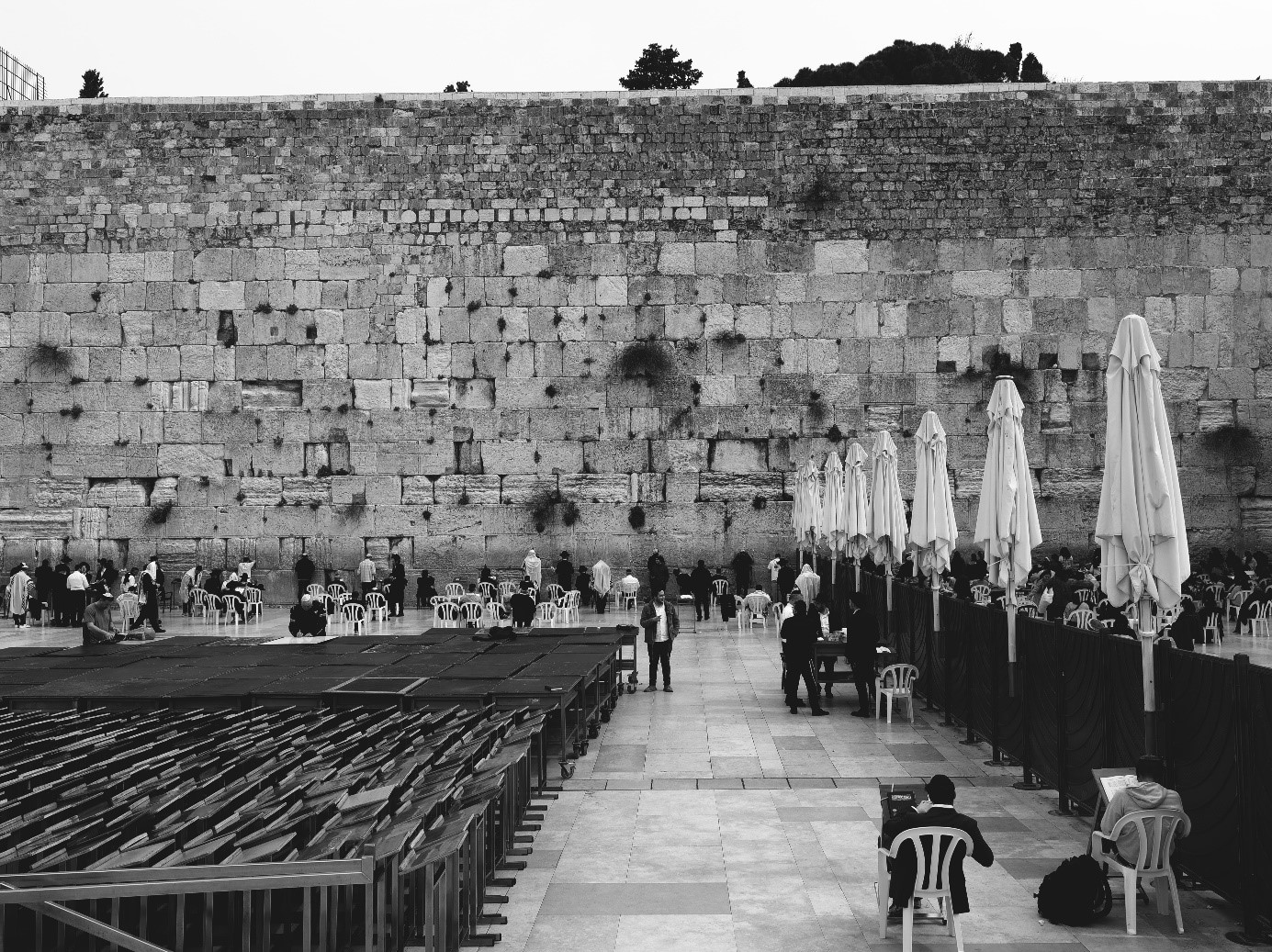
The Western Wall
The Al-Aqsa Mosque is located only 60 meters from the Western Wall. The mosque is considered the third-holiest site in Islam, after the al-Haram Mosque in Mecca and the Prophet’s Mosque in Medina. During the Crusader rule from 1099, the mosque was converted into a palace and served as the headquarters of the Knights Templar. After the reconquest of Jerusalem by Sultan Saladin in 1187, the Al-Aqsa Mosque was restored to its original purpose.
Today, the Al-Aqsa Mosque is administered by an Islamic trust (waqf). Access to the Al-Aqsa Mosque in Jerusalem has been a central point of conflict between Jewish Israelis and Palestinians for decades. From the Jewish perspective, the mosque was built on the Temple Mount, the site where, according to tradition, two significant Jewish temples once stood.
The religious significance of the site for both groups regularly leads to tensions and violent clashes.
In April 2023, during the Muslim fasting month of Ramadan, severe clashes occurred between Palestinian worshippers and Israeli police at the Al-Aqsa Mosque. The trigger was reports of planned Jewish rituals on the grounds. The police stormed the mosque, deploying tear gas and stun grenades, resulting in numerous injuries and over 350 arrests.
As early as May 2021, the situation escalated when Israeli security forces stormed the mosque, injuring hundreds of Palestinians. The repeated restrictions on access to the Al-Aqsa Mosque, particularly during religious holidays, are perceived by the Palestinian population as a provocation. The Israeli government justifies these measures with security concerns.
The Ritual of the Red Heifer
The conflict over the Al-Aqsa Mosque in Jerusalem is intensified by the actions of Zionist settler groups that seek to build a Third Temple on the Temple Mount. A central element of these aspirations is the ritual of the “red heifer” (Para Aduma), whose ashes, according to Jewish law, serve for ritual purification and are considered a prerequisite for the construction of the temple. Extremist Jewish groups have in the past attempted to bring red heifers to Israel in order to perform this ritual.
These activities are perceived by the Muslim community as a provocation and a threat to the status quo on the Temple Mount. Sheikh Ekrima Sabri, the preacher of the Al-Aqsa Mosque, has described the legend of the red heifer as “Jewish superstition” and emphasized that such rituals have nothing to do with the Al-Aqsa Mosque.
The current focus on Bezalel Smotrich and Itamar Ben-Gvir, the extremist settlers in the Israeli government, distracts from the actual causes of the conflict: the expansive, nationalist ideology of Zionism and the continued occupation of Palestinian territories.
The dispute over the mosque is another example of the misunderstanding that the conflict is primarily about religion; after all, the Hamas attack on October 7, 2023, also carried the internal title “Operation Al-Aqsa Flood.” Hamas published a seventeen-page document in English setting out the motives for the attack on October 7, 2023. The statement makes clear that religion plays only a subordinate role and that the conflict was about colonization and resistance, as it always has been.
The first sentences of the Hamas statement on October 7th read as follows: “The struggle of the Palestinian people against occupation and colonialism did not begin on October 7th, but 105 years ago, including 30 years of British colonial rule and 75 years of Zionist occupation. In 1918, the Palestinian people owned 98.5% of the land in Palestine and constituted 92% of its population.
While the Jews, who were brought to Palestine in mass immigrations coordinated between the British colonial authorities and the Zionist movement, managed to gain control of no more than 6% of the land in Palestine and constituted 31% of the population before the Zionist entity was proclaimed on the historic land of Palestine in 1948.” ⁴⁰
Perfidious Albion
The 30-year British colonial rule — the “Mandate period” — began with the conquest of Palestine by British troops in 1918. Before that, Palestine had been a province of the Ottoman Empire for 400 years.
During Ottoman rule, clans and families were the decisive reference groups in Palestine; the modern concept of a homogeneous nation-state only became globally dominant in the nineteenth century. The so-called Mandate system, established by the Allied Powers, was a form of colonialism and occupation that was intended to be temporary.
The system transferred rule over the territories previously controlled by the defeated powers — Germany, Austria-Hungary, Bulgaria, and the Ottoman Empire — to the victors.
The declared aim of the Mandate system was to enable the victors of the war to administer the newly emerging states until they could become independent.
Another event decisive for the conflict was the “Balfour Declaration” of November 2, 1917. The document marks a decisive turning point in the region’s history. In a brief letter, British Foreign Secretary Arthur James Balfour expressed to the influential Zionist Baron Rothschild the British government’s support for the establishment of a “national home for the Jewish people” in Palestine.
After Uganda and Argentina had fallen out of the running, the Zionist movement had focused on the creation of a Jewish state — that is, a European colony — in Palestine. The initial efforts, particularly negotiations with the Ottoman Empire, remained unsuccessful.
The geopolitical shifts during the First World War offered new opportunities and led to talks between British government representatives and Zionist leaders such as Chaim Weizmann. The result was the Balfour Declaration, which for the first time expressed the official support of the then-dominant world power for the goal of “the establishment of a national home for the Jewish people” in Palestine.
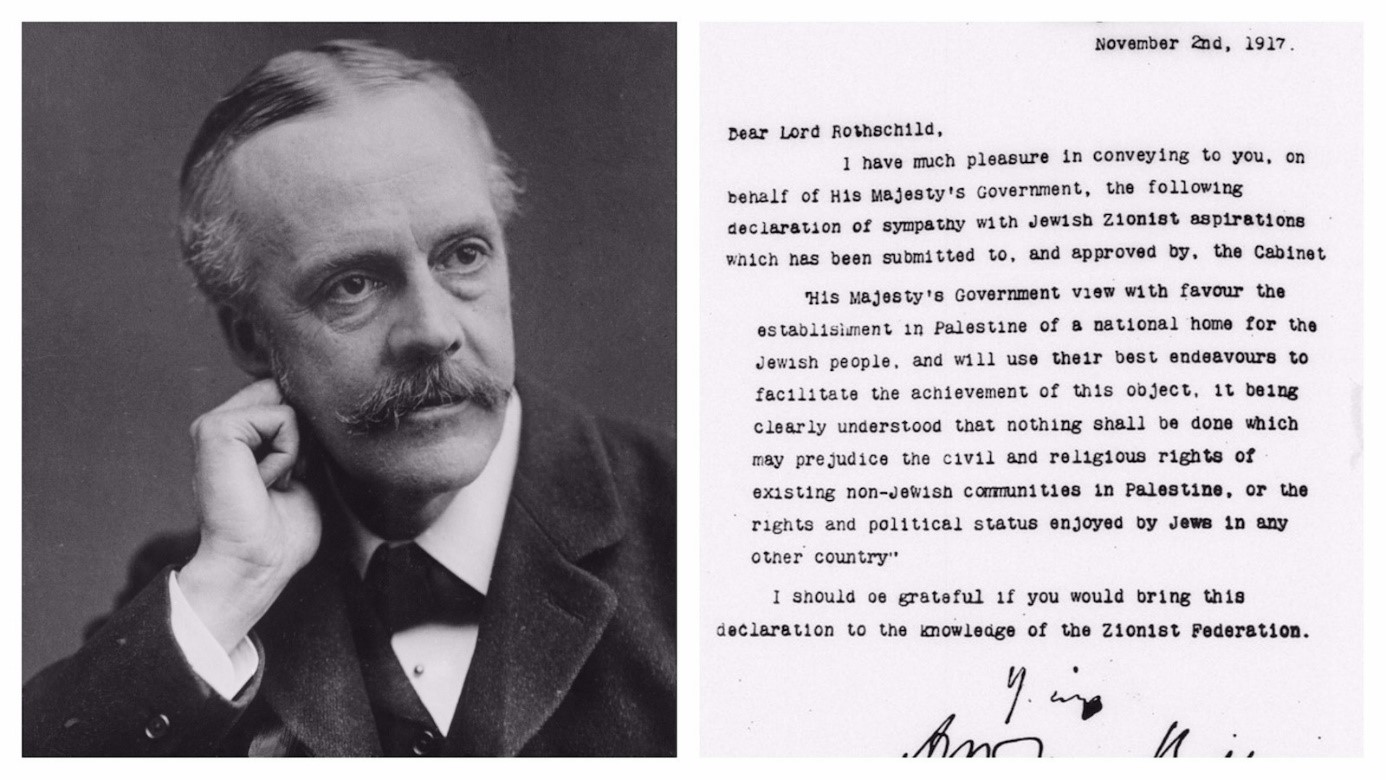
Lord Balfour
Here is the English text of the fateful letter:
Dear Lord Rothschild,
I have much pleasure in conveying to you, on behalf of His Majesty’s Government, the following declaration of sympathy with Jewish Zionist aspirations which has been submitted to, and approved by, the Cabinet.
His Majesty’s Government view with favour the establishment in Palestine of a national home for the Jewish people, and will use their best endeavours to facilitate the achievement of this object, it being clearly understood that nothing shall be done which may prejudice the civil and religious rights of existing non-Jewish communities in Palestine, or the rights and political status enjoyed by Jews in any other country.
I should be grateful if you would bring this declaration to the notice of the Zionist Federation.
In the gentle language of diplomacy and with an ambiguous formulation, the British Empire committed itself to supporting Theodor Herzl’s goals of Jewish statehood, sovereignty, and control over immigration throughout Palestine. Tellingly, the overwhelming Arab majority of the population — then approximately 94 percent — was not mentioned by Balfour, or rather was mentioned only in an insidious manner as “existing non-Jewish communities in Palestine.”
The Balfour Declaration is one of the rare documents of which it can be said with certainty that it decisively influenced the course of world history. The brief letter gave the Zionist movement momentum and led to increased immigration of European Jews to Palestine. At the same time, it laid the foundation for the conflict between the settlers and the indigenous population.

I wrote this essay because I am horrified that the German government has supported the massacre in Gaza. As a German citizen, I am disgusted by the misuse of Holocaust remembrance to support a genocide.