
I check out of the hotel and take my suitcase with me. I will leave Tel Aviv today and take the train to Jerusalem. Israel is very expensive, so I am glad to have found an affordable hotel in East Jerusalem. I intend to stay three nights in Jerusalem and would also like to visit the West Bank.
It is Day 138 of the Israeli bombardment of the Gaza Strip. So far, there are 29,000 dead and 70,000 injured. Thousands are missing or buried under the rubble. The Nasser Hospital in Khan Younis, one of the largest hospitals in the Gaza Strip, has been besieged by the Israeli army for two weeks. The Israelis have arrested 70 hospital staff members; 136 patients are trapped without electricity, food, or water; eight patients have suffocated due to a lack of oxygen.
At the end of April, after the withdrawal of Israeli forces earlier in the month, Gaza civil defense workers exhumed nearly 300 bodies from a mass grave on the grounds. Al Jazeera English reported: “Among the bodies are elderly women, children, and young men.” A spokesperson for the UN High Commissioner for Human Rights stated: “Some of them had their hands tied, which of course points to serious violations of international human rights standards and international humanitarian law.”
Propaganda Fantasyland
I arrive at the “Palmach” Museum on time and am greeted warmly, as the day before. I leave my luggage with the female reservists who apparently serve their military duty at the ticket counter. The group I am to accompany is already there.
They are teenagers, a school class. The visit to the history museum is apparently mandatory; the kids look disinterested; many are staring at their phones. I receive an English-language audio guide, and then we get going.

Hero’s grave in the Palmach Museum, Tel Aviv
We are led down a dark corridor and arrive at a large rectangular structure reminiscent of a gigantic grave. The room is dark; only the structure itself is illuminated. At the head of the rectangle hangs a sculpture resembling two book pages, bearing the symbol of the “Palmach” — a sword between two stylized ears of grain. The sides of the open rectangular structure, the hero’s grave, are completely covered in Hebrew script — the names of the fallen heroes of the “Palmach.”
Target-Audience-Appropriate Creation of Reality
From this moment on, it is clear that this is not a normal museum but yet another building block of the monumental Zionist propaganda project. The path into the museum leads around the hero’s grave. We enter the first room: No exhibits, no critical contextualization. Instead, the room displays a set from Palestine during the period of British rule — a street scene with a market stand, bicycle, and café. The set enhances the short film on the large video screen, making it appear more vivid and realistic.
The film tells the first chapter of the story of a group of Jewish teenagers, recruits of the “Palmach,” and follows the group’s story from the Mandate period to the 1948 war and the founding of Israel. The school group with which I walk from room to room is no coincidence. Young people were obviously the target audience of the planners of this gigantic, propagandistic video installation. The goal is not the transmission of knowledge and the promotion of critical thinking; the goal is reliving, immersive experience, total identification, and thereby a narrowing of perspective.
In the style of a modern soap opera, like “Friends” or “Neighbours,” young viewers are offered characters to identify with — teenagers who come to Palestine from various parts of the world and fight together for the creation of Israel. The army is the cradle and engine of the Israeli nation, as it is now.
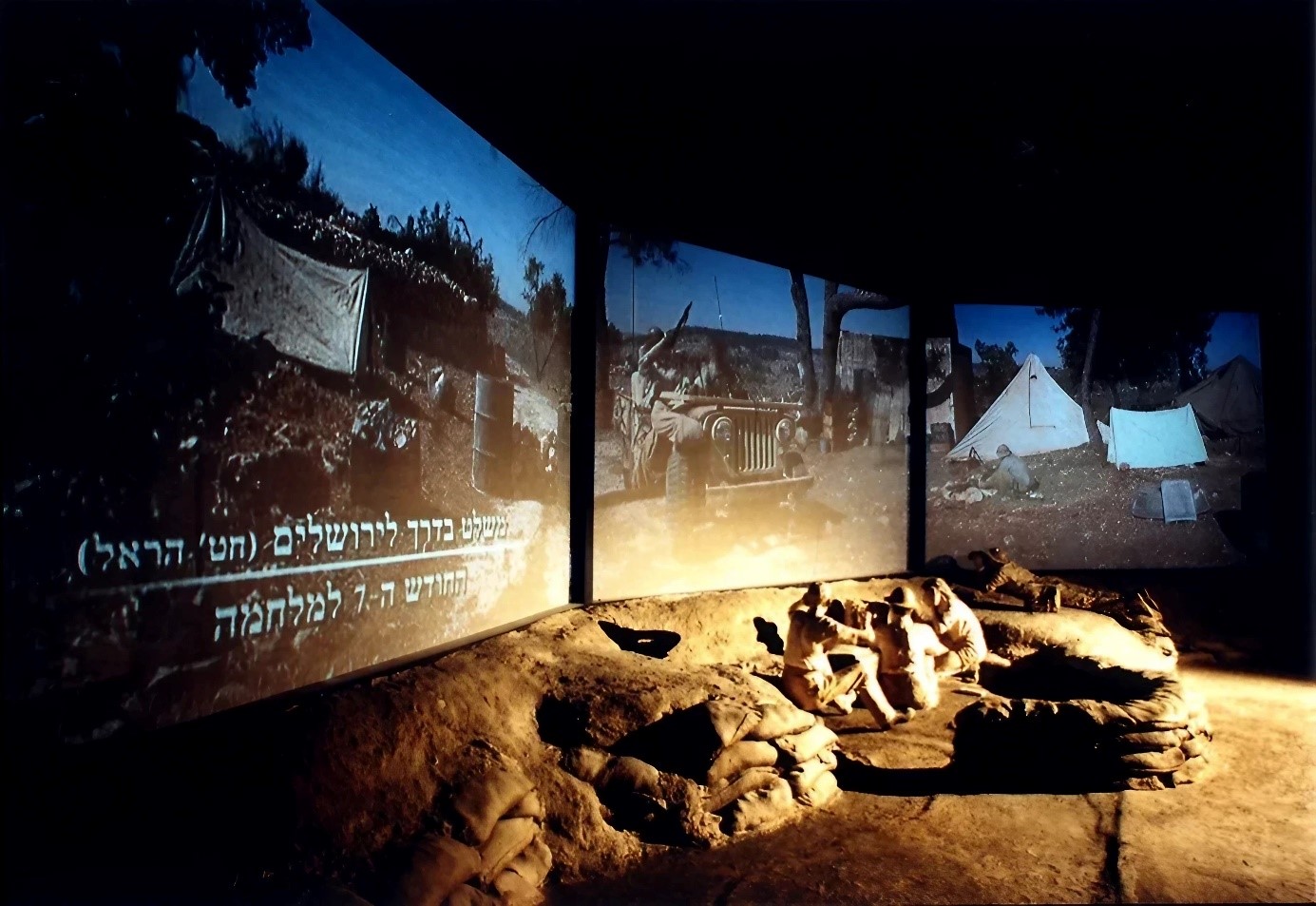
Room in the “Palmach” Museum: A gigantic, propagandistic video installation
The films celebrate campfire romanticism and camaraderie, show a sentimentally transfigured image of military life, and buttress the myth of little, threatened Israel that, thanks to bravery and cleverness, wins the war against several Arab states.
After the historic victory, they set about constructing the outpost of European civilization in the land of the barbaric Arabs.
The brutal ethnic cleansing of the Palestinian population, in which the “Palmach” troops were significantly involved, is not mentioned with a single word. This museum, too, does not pursue the intention of reconstructing and critically reflecting on the past. It aims to stage a myth in a target-audience-appropriate manner and to create a false reality.
Dreams, Songs, Fantasies, and Black-Red-Gold Ribbons
All nations use propaganda and deliberately falsify reality. One of the differences between Israel and other nations lies in the fact that it was not first a group that lived in one place for a long duration and then elevated itself to nationhood with the help of myths and propaganda. Israel is the special case of a nation that begins with myth and propaganda and has to laboriously assemble its group.
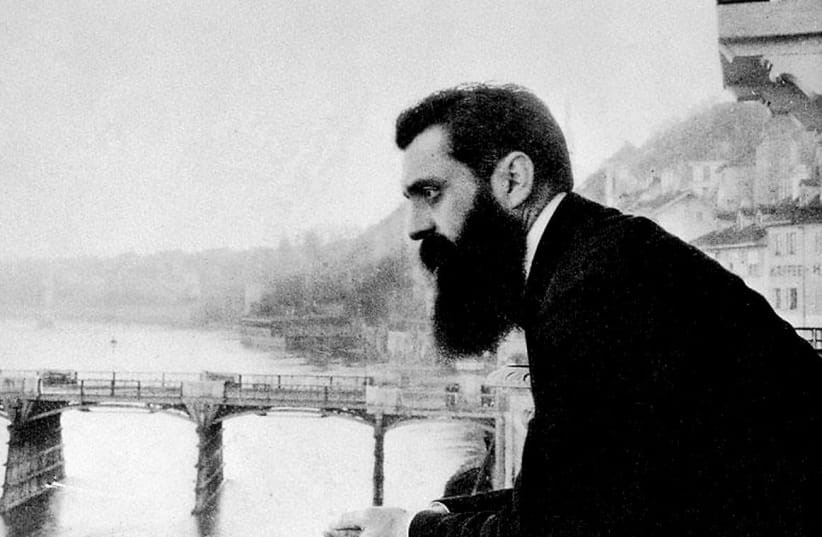
Theodor Herzl at the Hotel Les Trois in Basel
Israel was founded more than any other modern nation on the conscious use of symbols and propaganda. Herzl described the propaganda plan for Israel in a letter to Baron Hirsch as follows: “For a flag, men live and die; it is indeed the only thing for which they are willing to die in masses. Do you know how the German Empire was created? Dreams, songs, fantasies, and black-red-gold ribbons.”
Zionism was, from the beginning, not an intellectual system. It has always relied on Herzl’s formula of symbolism, emotions, and slogans. By drawing on symbols from Jewish tradition, the Zionists suggested the authority of that tradition without directly invoking it.
For it was also an attempt to displace religion by capturing the meaning of its symbols in order to establish a secular order. After the Holocaust, the Zionists made even more intensive use of this formula and constantly instilled in their followers the fear of a new Hitler in order to fan their nationalist sentiments.
Ironies of History
As a German, I am a citizen of a country that, after initial willful blindness, at least partially confronted its dark past. In my generation, there was a recognizable effort to immunize oneself against the dangers of nationalist propaganda. It is yet another bitter, hard-to-bear irony of history to encounter precisely this murderous phenomenon in the land of the descendants of the Holocaust’s victims.
But Israel and Zionism are not identical with Judaism. It is especially important for Germans to be aware of this fact. A large number of Orthodox and secular Jews are and were anti-Zionists. The beginnings of modern Zionism lie in the late nineteenth century. It is a product of the colonial era, the time that the British historian Eric Hobsbawm dubbed “The Age of Empire.”
Zionism is a product of modernity, an ideology that set itself the goal of creating a new human being.
The contemptible “Yid,” the “Mauschel,” was to become the proud, violence-ready Hebrew. It is an ideology that has much in common with fascism and little with the Jewish religion.
Thanks to the categorical dehumanization of the Palestinians, many modern Zionists have come cruelly, repulsively close to the ideal of their founding thinkers. The countless cell phone videos of Israeli soldiers in which they celebrate their genocide with malicious glee and perfidy and film themselves torturing Palestinians are testimony to the effectiveness of a lifeworld created according to propagandistic goals — a gigantic “Propaganda Fantasyland.” The much-invoked Jewish humor mutates here into sadistic schadenfreude.
Social Media Genocide
One video, for example, shows dozens of Palestinian prisoners from Gaza, bound and blindfolded, sitting in a bus. An Israeli soldier then instructs them to praise his family and declare that they want to become slaves of his family “forever and ever.” ¹⁶
Complaining about power supply problems in destroyed houses in Gaza is a popular gag of the Israeli forces. ¹⁷
The IDF even had an Israeli “influencer” mockingly “review” a “hotel” — that is, a civilian house in Gaza devastated by the army. ¹⁸
“The dehumanization of Palestinians is now normative and omnipresent,” writes Israeli historian Lee Mordechai. I found the example videos in his highly recommended online archive “Witnessing the Gaza War.” ¹⁹
Still Susceptible to Propaganda
Especially we Germans — the world champions of remembrance, who watch docudramas about the Wannsee Conference on Friday evenings — should be on guard against the power of dehumanizing propaganda. Then we would have learned something. Unfortunately, the lesson was obviously not understood. We seem to think that Nibelung loyalty to those we define as the descendants of our victims is our sacred duty.
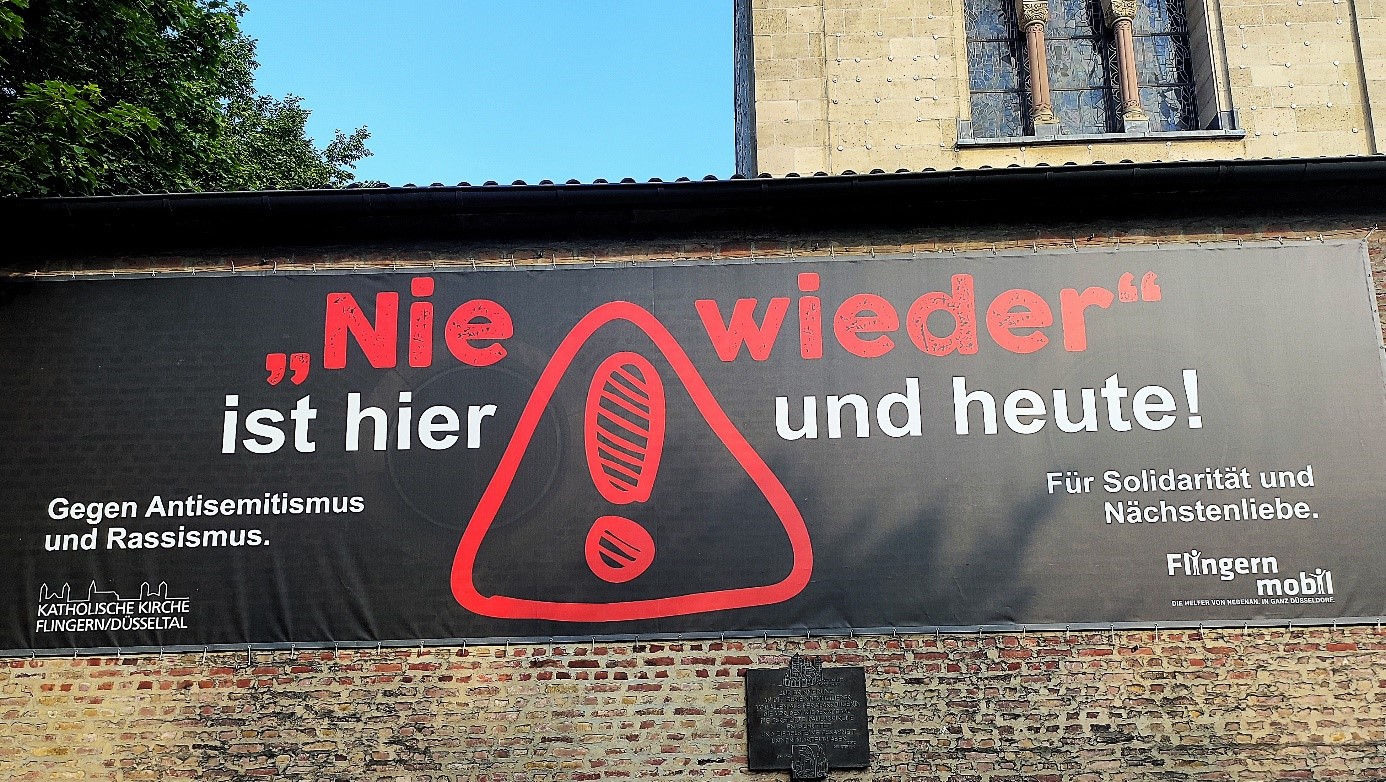
Poster, Pauluskirche, Düsseldorf, 2024
We are readily willing to repeat the mistake; only the group changes. It seems as though, despite all official protestations, we have learned nothing, as if no transfer has taken place. I write “we,” but do so for stylistic reasons. I very much hope that a large portion of the German population has preserved its humanity and is, just like me, disgusted by the behavior of the German government.
What the Palmach “Museum” omits, the Israeli historian Ilan Pappé reconstructs with meticulous precision in his book The Ethnic Cleansing of Palestine. It is regrettable that this important Jewish thinker is hardly known in Germany, and his work meets with little interest. It seems as though we are once again willfully blind. Ilan Pappé is one of the most influential Israeli historians. Born in 1954 in Haifa, his work is devoted to revising Israeli historiography.
Pappé belongs to a group of historians who became known as the “New Historians.” This group — which also includes well-known names such as Benny Morris and Avi Shlaim — began in the 1980s to comb through the Israeli archives when documents about the War of Independence were declassified.
The discoveries they made contradicted the national narrative that had been firmly anchored for decades.

In his work The Ethnic Cleansing of Palestine, Pappé shows that the expulsion of the Palestinians was not a random byproduct of war but a planned and systematic act carried out by the Zionist leadership from 1947 to 1949. His research, which also points to “Plan Dalet,” a 1947 plan, sparked fierce controversy in Israel.
Pappé’s book exposes the founding myth of Israel as a lie, particularly the portrayal of the events surrounding the founding of Israel in 1948 and the “Nakba” — the expulsion and flight of approximately 750,000 Palestinians. The “New Historians” used declassified government documents to reveal previously unexplained or deliberately suppressed details of the state’s founding. These sources were largely accessible because Israel — similar to Great Britain — applied a 30-year rule for the declassification of foreign policy documents.
Willfully Blind Again?
Pappé, one of those rarely found individuals who combine intellectual brilliance and moral courage, went further than many of his colleagues and spoke openly of war crimes and ethnic cleansing. He also supported the academic boycott of Israel and advocated for the right of return of Palestinian refugees — positions that made him an outsider in Israel.
In 2007, Pappé left Israel and moved to Exeter, England, where he now heads the European Centre for Palestine Studies. He was forced to leave Israel after he and his family received death threats. The question remains: why does a historian who uncovers important, uncomfortable truths not receive more attention in Germany? Ilan Pappé should be a central figure in the German discourse on the Middle East.
Plan Dalet
What follows is the uncomfortable truth about the expulsion of the Palestinians. These are the facts without which the conflict between the settlers and the indigenous population cannot be understood. The attackers of October 7, 2023, are the children and grandchildren of those who were expelled from their towns and villages in 1948 and have been inmates of a vast prison camp for decades. It is the uncomfortable truth that Germany does not want to know about, and that is concealed from the young visitors of the propagandistic video installation.
The Palestinians call it the “Nakba,” the Catastrophe; the Zionists called it “Plan Dalet”: “The orders contained a detailed description of the methods to be used for the forcible eviction of the people: massive intimidation, siege and shelling of villages and population centers, setting fire to houses, property, and goods, expulsion, destruction, and finally the mining of the rubble to prevent the expelled inhabitants from returning.”
“After the decision was made, it took six months to complete the mission. When it was over, more than half the indigenous population of Palestine — nearly 800,000 people — had been uprooted, 531 villages had been destroyed, and eleven urban neighborhoods had been emptied of their inhabitants. The plan decided on March 10, 1948, and especially its systematic implementation in the following months, was a clear case of ethnic cleansing, which today constitutes a crime against humanity under international law.”
“When the Zionist movement founded the nation-state, it did not wage a war that ‘tragically but inevitably’ led to the expulsion of ‘a part’ of the indigenous population; rather, it was the reverse: The main objective was the ethnic cleansing of all of Palestine, which the movement coveted for the new state.”
Proceeding Without Mercy
“The perpetrators are not unknown — they are a very specific group of people: the heroes of the Jewish War of Independence (whose names will be quite familiar to most readers). The list begins with the undisputed leader of the Zionist movement, David Ben-Gurion, in whose private home all the early and later chapters of the history of ethnic cleansing were discussed and decided.”
Here is Pappé’s description of the role the “Palmach” played during the ethnic cleansing: “An important part of the Zionists’ military efforts was the training of a special commando unit, the ‘Palmach,’ which was founded in 1941. Originally, it was created to support the British army in the war against the Nazis, should they reach Palestine.
Soon, the zeal and activities of the ‘Palmach’ were directed against the rural areas of Palestine. From 1944 onward, it was also the most important pioneer force in the construction of new Jewish settlements. Before its dissolution in the autumn of 1948, its members were very active and carried out some of the largest cleansing operations in the north and center of the country.
The “Palmach” commander and folk hero Yigal Allon distinguished himself through a particular willingness for cruelty. His statements, recorded in Ben-Gurion’s diaries, make clear that the will for mass murder of civilians was present long before October 7, 2023: “There is now the need for a harsh and brutal response. We must be precise regarding time, place, and the people we attack. If we accuse a family, we must proceed against them without mercy, including women and children. Otherwise, it is not an effective response. During the operation, there is no need to distinguish between the guilty and the innocent.”
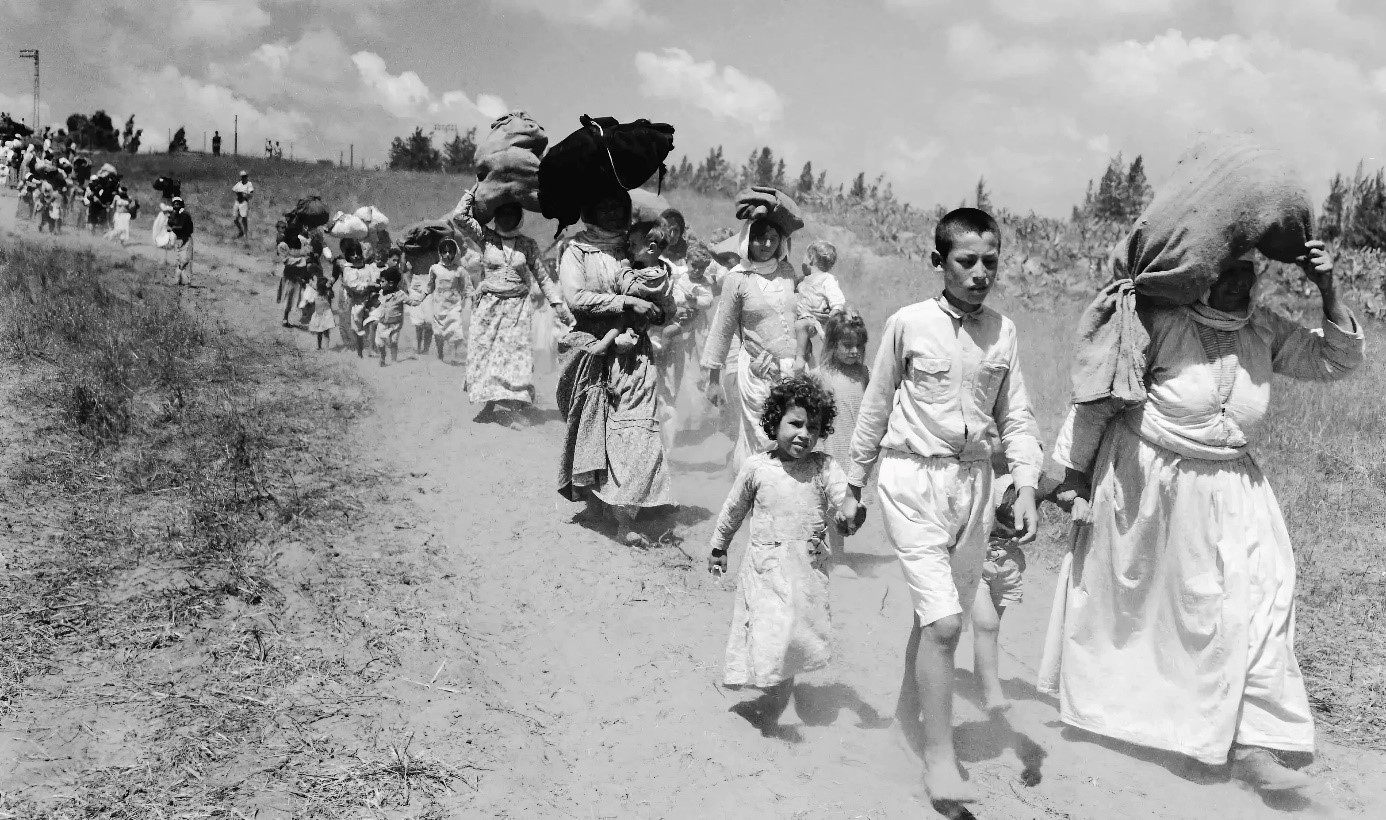
1948 — Palestinian women and children from near Haifa flee during the “Nakba.”
Taking Over Palestine as a Whole
The instrumentalization of the Holocaust by the Zionist leadership elite also has a tradition: “In public, the leaders of the Jewish community brandished doomsday scenarios and warned the Jewish population of an imminent ‘second Holocaust.’ In private circles, however, they never used this discourse. They were fully aware that Arab rhetoric was in no way matched by serious preparations on the ground.”
A letter by Ben-Gurion quoted by Pappé leaves no room for doubt about the actual situation: “If we receive in time the arms we have already purchased, and perhaps even some of the arms promised to us by the United Nations, we will be able not only to defend ourselves but also to deliver the death blow to the Syrians in their own country — and to take over Palestine as a whole. Of this I have no doubt. We can take on all the Arab armed forces. This is not a mystical belief, but a cold and rational calculation based on a practical examination.”
Key Events Must Be Denied
In Israel, the denial or suppression of the “Nakba” is widespread and is considered necessary for the maintenance of the national myth. Ilan Pappé is of the view that this refusal to accept historical reality not only ignores Palestinian suffering but also undermines the possibility of genuine reconciliation between Israelis and Palestinians. Pappé is co-founder and chair of the “Nakba Memorial Foundation”. This England-based foundation has set itself the goal of combating the denial of the “Nakba.”
On the foundation’s website, the following analysis of Nakba denial can be found: “It is common practice for settler-colonial regimes not only to establish themselves through the expulsion of the indigenous population from the territory in question and to subjugate those who remain, but also to eliminate the memories and historical narratives of the indigenous population. History must be the history of the rulers arriving. No other narrative may survive that could call into question the supposed legitimacy of the settler-colonial regime. Key events in history, as experienced and remembered by the indigenous people, must be denied.
This practice was applied in virtually all territories where settler-colonial regimes established themselves, from the Americas to Africa to Australia. Historical memories and perspectives of the local population were denied, and in some cases, documents and cultural relics that supported local narratives were destroyed. The same applies to the Israeli settler-colonial regime that established itself in Palestine.” ²⁰
Train to Jerusalem
I collect my luggage from the reception and make my way to the “HaHagana” station in southern Tel Aviv to take the train to Jerusalem. Pride in the violent history of the country’s founding is omnipresent in Israel; the station bears the name of the Zionist militia from which the Israeli army emerged and to which the “Palmach” special commando unit also belonged.
Two young men in civilian clothes wait with me for the train, casually carrying their old M16s over their shoulders. At this point, the sight of the rifles surprises me; later, I realize that firearms are ubiquitous in Israel.
The two seem to consider themselves tough guys, cool warriors. I find their posturing repulsive, especially when I think of the Israeli army’s actions in Gaza. The “IDF,” the “Israeli Defense Force,” relies primarily on its air force and its technological superiority. The Israeli Air Force makes no distinction between “guilty and innocent” and deliberately destroys residential buildings, hospitals, and schools from the air with 900-kilogram bombs.
Initially, the “Hasbara” specialists — the IDF’s propagandists — still went to the trouble of producing a video animation of an alleged “Hamas” command center under the “Al Shifa” hospital. By now, they attack hospitals, schools, and tent camps at will and simply claim that terrorists are present there.
No Distinction Between Civilians and Combatants
The renowned Italian jurist Francesca Albanese, since 2022 UN Special Rapporteur for the Occupied Palestinian Territories, summarizes the IDF’s conduct in her report “Anatomy of a Genocide” as follows: “A core feature of Israel’s conduct since 7 October has been the intensification of its ‘de-civilianization’ of Palestinians, a protected group under the Convention. Israel has used the terminology of international humanitarian law to justify its systematic use of lethal force against Palestinian civilians as a group and the widespread destruction of life-sustaining infrastructure.
Israel has done this by using concepts of international humanitarian law such as human shields, collateral damage, safe zones, evacuations, and medical protection so liberally that these concepts have been stripped of their normative content, their protective purpose undermined, and ultimately the distinction between civilians and combatants in Israeli operations in Gaza has been eroded.” ²¹
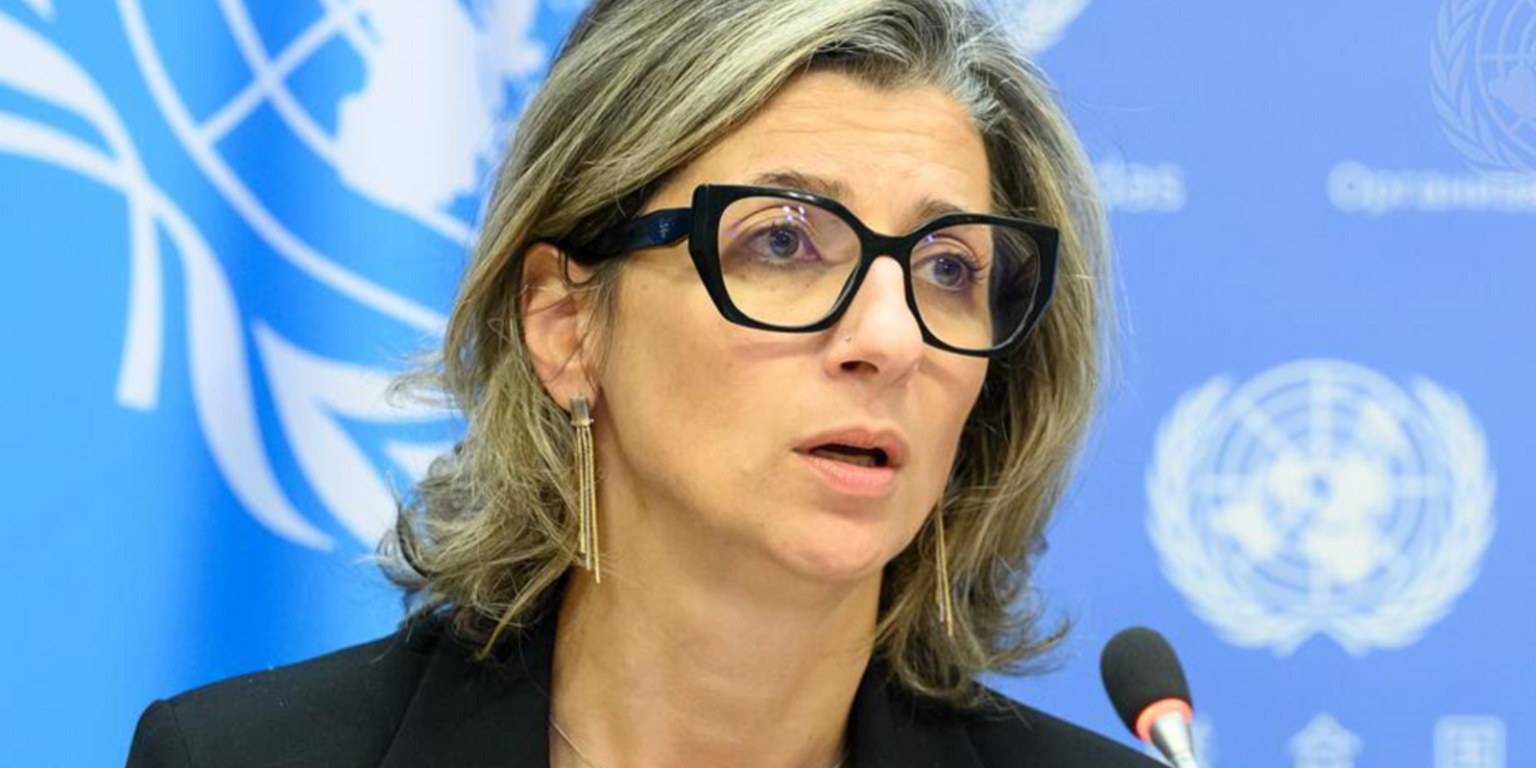
Another victim of the instrumentalization of the antisemitism accusation: Francesca Albanese
The IDF’s conduct is so extreme in its cruelty that Alan Shebaro, a highly decorated veteran of the American Special Forces, was so disgusted that he felt compelled to go public with his moral revulsion during a city council meeting in McKinney, Texas. Shebaro briefly summarized his career with the Green Berets before the city council and then got to the point: “I know what war is. What is happening in Gaza is not war.”
It was the evening on which the United States used a veto in the UN Security Council for the third time to prevent a ceasefire in Gaza. The video clip of his short speech went viral in the USA; to my knowledge, it was not reported on in Germany at all. ²²
The Transmission of a Nationalist Attitude
The two young men with the M16s are only a few years older than the teenagers with whom I just visited the propagandistic video installation. They grew up in a country whose leadership elite has been manipulating the population since its founding. The foundation for the Zionist propaganda edifice was laid through the denial of the ethnic cleansing at the founding of Israel.
By now, indoctrination begins as early as kindergarten, and the time in the army serves to put what was learned in theory into practice.
For his book Goliath, available only in English, the American journalist Max Blumenthal interviewed Nurit Peled-Elhanan, who at the time was working as a Professor of Comparative Literature at the Hebrew University of Jerusalem. Peled-Elhanan had published a study on Israeli school textbooks in Europe and the USA in 2012. The study covered seventeen textbooks on history, geography, and civics; in Hebrew, the work was never published.
The results point to patterns familiar from the “Eretz Israel” and the “Palmach” museums: In none of the textbooks did Palestinians or their culture receive a positive mention. Palestinians are ignored or depicted as terrorists, refugees, and primitive farmers. Israeli school textbooks serve as media for the transmission of a nationalist attitude, through explicit and implicit messages.
How to become a good soldier
“This is a clear socialization process. The state enforces a single viewpoint, a single narrative that excludes and displaces all other possible representations. In this way, the state creates a situation in which Palestinian life is expendable and can be ended with impunity. The goal is to educate good soldiers,” explains Peled-Elhanan in the interview.
Blumenthal lived in Israel for months to research his book, published in 2013. Anyone who reads his book gains the impression that the genocide in Gaza was foreseeable. It is not surprising that the American-born diaspora Jew Blumenthal is vilified by Zionist propaganda as a “self-hating Jew.”
The scholar Peled-Elhanan, who lost her daughter in a Palestinian suicide bombing, is no longer a professor at the Hebrew University in Jerusalem. She was dismissed in 2024 and charged with supporting terrorism because, during a conversation in a WhatsApp group, she commented on a colleague’s post equating Hamas with the National Socialists with a Jean-Paul Sartre quote. ²³
Every Accusation Is a Confession
There is no question that service in the IDF is a central building block of indoctrination and makes the reservists complicit. That may be one reason why social cohesion in Israel is so high: crossing ethical boundaries together creates bonds. The comparison with the indoctrination of the population by the National Socialists suggests itself here, albeit with the difference that the NSDAP was only in power for twelve years, while Zionist indoctrination has been going on for several decades.
That the Palestinians teach their children hatred and antisemitism is one of the Israelis’ talking points — this is how they try to justify their mass murder in Gaza. “Every accusation is a confession” is a phrase one hears often when it comes to Zionism, and it applies here as well.
Anyone who studies the history of the Palestinians is more likely to wonder at how moderate and willing to compromise many of them were for so long, despite all they have had to endure. Even Hamas makes clear in its revised charter of 2017 that its resistance is directed against the Zionist colonial project and not against Judaism: “Hamas affirms that its conflict is with the Zionist project and not with the Jews because of their religion. Hamas does not wage a struggle against the Jews because they are Jewish, but wages a struggle against the Zionists who occupy Palestine. It is, however, the Zionists who constantly identify Judaism and the Jews with their own colonial project and their illegal entity.” ²⁴
This is not to say that Hamas or the Palestinians are free of antisemitism, but antisemitism is not the motive for the armed struggle. Parents do not need to teach their children hatred of the colonial power, Israel. The Israelis take care of that themselves by treating the Palestinians as second-class human beings, dispossessing them, murdering them by the thousands, and torturing them in prisons.
Ilan Pappé describes the attitude of the majority of the Palestinian population before the “Nakba” as follows: “Over the centuries, the land had passed from one hand to another, belonging alternately to European and Asian invaders and long forming part of a Muslim empire. The lives of the people, however, had hardly changed: they tilled the land or traded wherever they were and quickly adapted to the new situation until it changed again.
Therefore, village and town dwellers alike patiently waited to see what it would mean to be part of a Jewish state or another new regime that might replace British rule. Most of them had no idea what was coming, and that what was about to happen would represent an unprecedented chapter in the history of Palestine: not merely a transition from one ruler to another, but the actual dispossession of the people living on the land.”
The Inn of Syrian Christians
The journey from Tel Aviv to Jerusalem takes just under an hour. Jerusalem, in Arabic “Al-Quds,” is home to the Western Wall, the Church of the Holy Sepulcher, and the Al-Aqsa Mosque, the third-holiest site in Islam. Everywhere in the Jerusalem train station, the Israeli flag hangs. I have booked a room in a Christian hostel in East Jerusalem and have printed out the address as a precaution.
I show the address to some taxi drivers, but to my surprise, they are dismissive and claim they don’t know it. Only Tamir, a Palestinian taxi driver, knows the address and is willing to take me. I estimate Tamir to be in his late 20s. He wears a gelled 1980s quiff and a Guess T-shirt. He speaks fluent English, and I ask him how it is possible that the other taxi drivers did not know the address.
He suspects that the other taxi drivers were Jewish Israelis who are reluctant to drive into Palestinian-inhabited East Jerusalem. Tamir is polite but reserved. I try to keep the conversation going because I am looking for someone to drive me to the West Bank.
Good Location
Bethlehem seems to me an innocuous destination that would be easy to explain to soldiers at the dreaded checkpoints. Only when we talk about Gaza, and I express my horror at the mass murder of the population, does Tamir warm up. He had obviously assumed that, as a German, I would stand firmly on Israel’s side.
Tamir agrees to drive me to Bethlehem. A few minutes later, we arrived at my hostel and exchanged phone numbers. The “St Thomas Home’s Guesthouse” is located on a narrow side street off Nablus Road, only 600 meters from the Damascus Gate and the Old City of Jerusalem. The simple hotel was originally founded for Christian pilgrims from Syria; on the ground floor, there is a Syrian Orthodox chapel.
The chapel is a simply designed room with low, round arches and an unadorned stone wall. Against this background, the icons painted in tones of red, gold, and green stand out even more. Striking are the flat perspectives and the elongated, solemn faces of the saints.
I am too early; my room is not ready yet. I deposit my luggage and use the time to explore the neighborhood. I had not looked at the hotel location carefully on the map beforehand; I had only seen that it was near the Old City. As I slowly walk down Nablus Road, past Palestinian fast-food and candy stands, I realize that the hostel’s location could not be more ideal: after barely 10 minutes, I am standing at the steps leading down to the Damascus Gate.
The Damascus Gate, in Arabic “Bab el-Amoud,” is the largest and most impressive of the seven open gates of the Old City of Jerusalem and is used mainly by Palestinians and tourists. Around the roughly 12-meter-high walls of the gate, there is a large, semicircular amphitheater where Palestinians used to gather with friends and family to drink coffee.
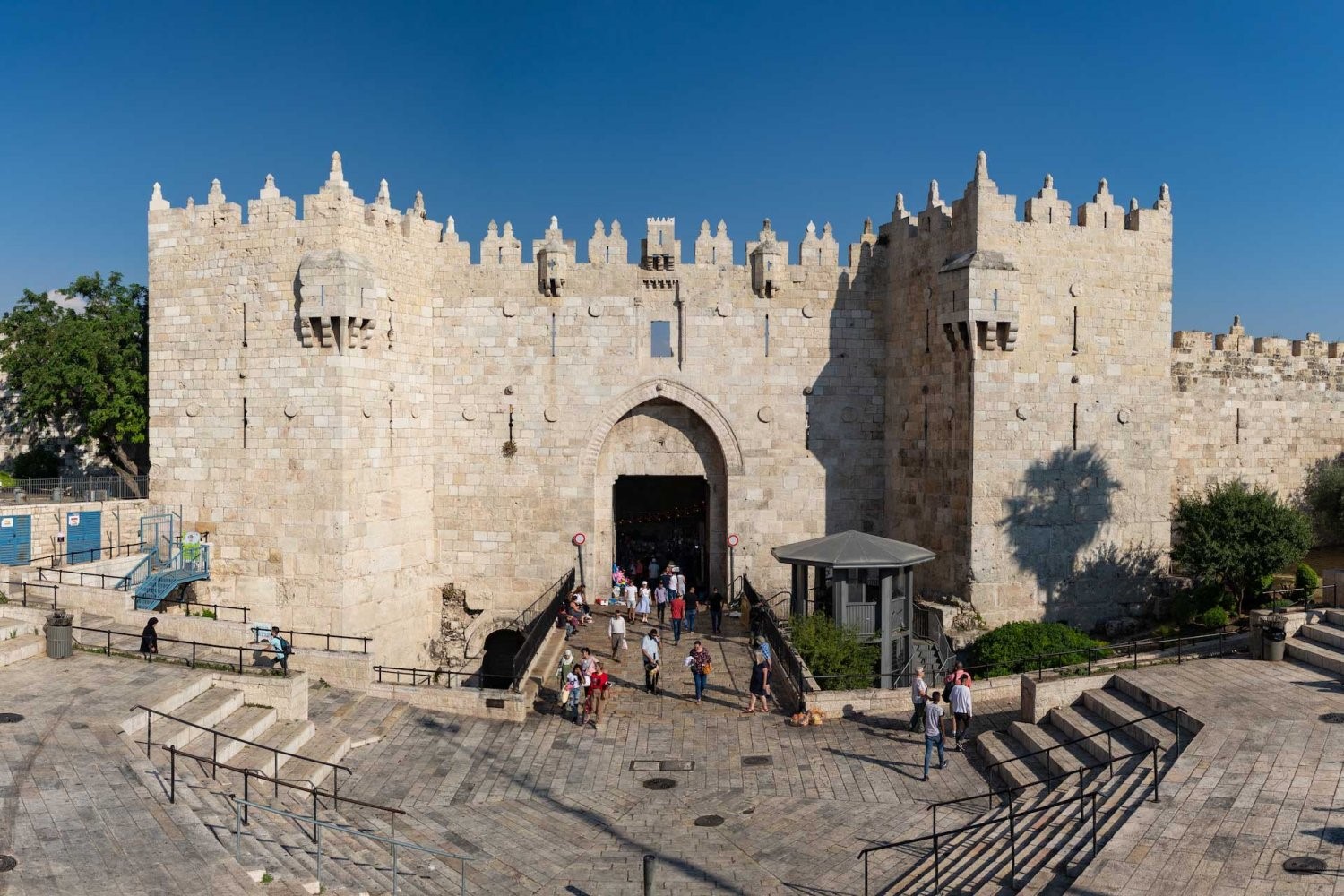
Damascus Gate
The Goal Is Silent Expulsion
At the head of the stairs and at the gate entrance, there are fortified checkpoints of the Israeli army. East Jerusalem is an annexed and occupied territory, even though at this moment only a few soldiers are present in the large, covered checkpoint. After the end of the 1948 war, the city was divided into a Jewish-settled west and an Arab-settled east under Jordanian rule.
The renowned Palestinian journalist Khalil Assali describes in an article for the blog “Jerusalem Story” what happened next: “Israel occupied East Jerusalem in June 1967 and wrested control from Jordan. In the aftermath, the Israeli authorities did everything to suffocate life on the eastern side of Jerusalem, yet it remained a commercial center and the heart of Palestine. The ‘Musrara’ quarter was the commercial and transportation hub that connected the northern and southern parts of the West Bank with the Gaza Strip. Jerusalem retained its role as a cultural center through its newspapers, magazines, unions, and associations.
But this too ended after the signing of the Oslo Accords and the founding of the Palestinian Authority in the mid-1990s. For Jerusalem’s residents, the Oslo Accords were a catastrophe. The Oslo Agreement led to the separation of East Jerusalem from the rest of the occupied Palestinian territories without integrating it into the economy of the western part of the city.
Israeli policy focused on annexing the Palestinian parts of Jerusalem and imposing Israeli sovereignty over them without, however, integrating the Palestinian residents. The goal of Israeli policy is to reduce the number of Palestinian residents through silent expulsion as much as possible.” ²⁵
Oath Before the Western Wall
The soldiers ignore me, and I walk down the steps to the gate. The amphitheater is deserted; later, I read that the occupiers have forbidden the locals from gathering there.
I pass through the Damascus Gate and continue aimlessly straight ahead over the cobblestones of the winding street, past stands and shops selling phone cases, socks, backpacks, T-shirts, toys, incense, fruits, kebab, and sweets. The streets of the Old City of Jerusalem are narrow and winding; the stone floor is polished smooth by centuries of use.
In the alley, shops line up one after another; the shop owners stand waiting in front of them, but customers are missing. Some speak to me, and I let myself be persuaded to buy a pack of particularly long incense sticks. In between, Israeli soldiers of both sexes stand repeatedly behind metal barriers — all appear very young and can barely be older than 20. Some have their M16s casually at the ready, or with the muzzle resting on the metal barrier in front of them.
A double first: It is the first time I find myself in an occupied territory, and the first time someone points a loaded firearm at me. After about fifteen minutes, I reach a tunnel with a security checkpoint and metal detectors at its entrance. I pass through the security check and arrive at an enormous square full of soldiers.
It takes a moment before I realize that I have arrived at the large square in front of the Western Wall and that a swearing-in ceremony for Israeli recruits has just taken place here.
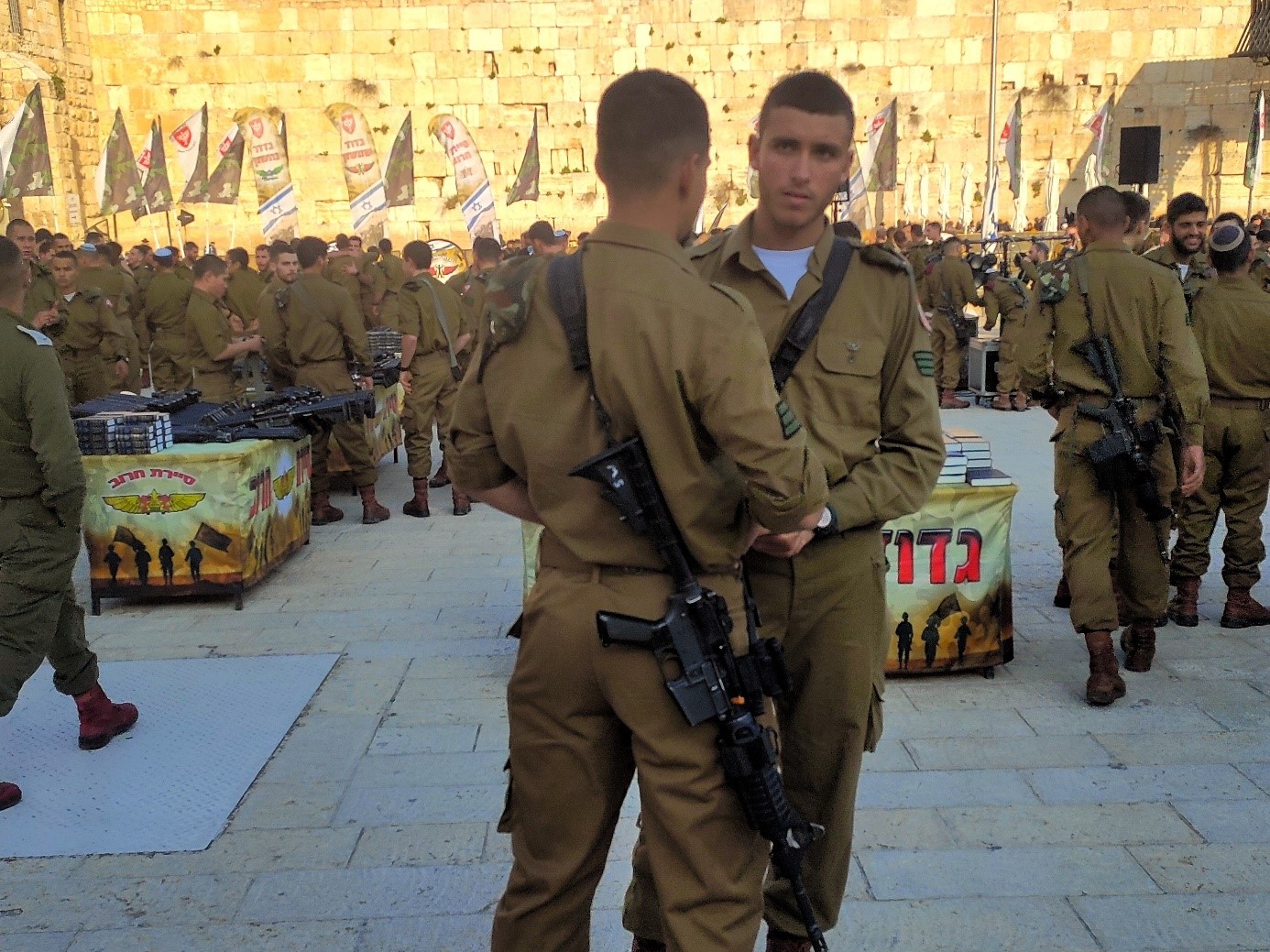
The golden dome of the Dome of the Rock towers above the two-thousand-year-old wall built from massive stone blocks. It is an impressive setting for an oppressive scene. Everywhere there are tables on which automatic rifles lie beside Bibles. The atmosphere is reminiscent of the relaxed beginning of a youth trip: teenagers stand around in small groups, chat, flirt, make phone calls, or grab a kebab. Proud parents take photos with their children in uniform. The good mood is almost unbearable.
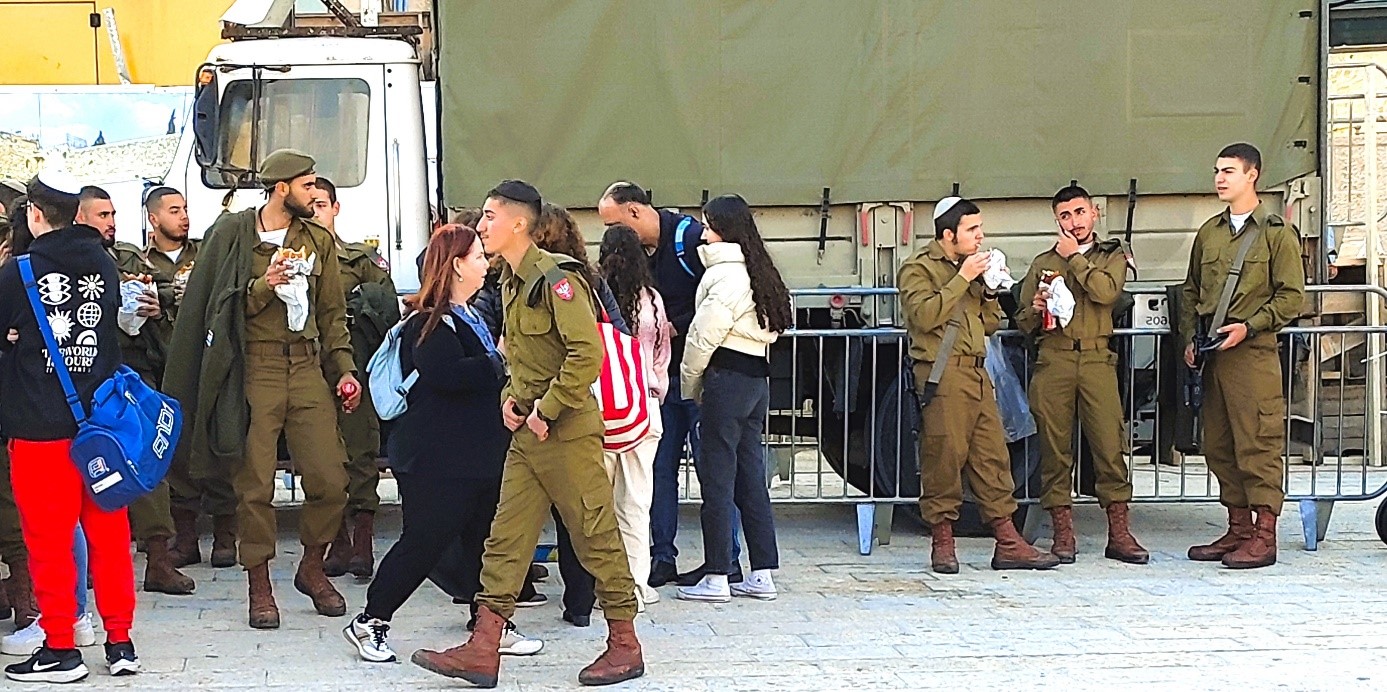

The entire scene, especially the Bible that each recruit receives along with his or her rifle, is a staging, a promotional clip that has nothing to do with preserving a tradition. Even the ceremonial square in front of the Western Wall is no ancient gathering place but was created in 1967, after the Israeli occupation of Jerusalem, by demolishing an entire neighborhood.
Zionism is a child of modernity, of the age of the spectacle. The haka dance of the All Blacks, New Zealand’s rugby national team, is more authentic than this pseudo-religious oath before the Western Wall. Here, a religious text is being misused to justify a nationalist myth. The army is simultaneously the guarantor of Israeli security, the nation’s educational institution, and the symbol of the state, both internally and externally.
The careful staging — the aesthetics — plays an important role in maintaining the national myth. The Palestinian intellectual Abdaljawad Omar writes: “The choreographed movements of soldiers and armored vehicles, the seamlessly integrated technology, the courage displayed by the armed forces, the ability to demonstrate one’s power through its aesthetic effect and performance, the assassination of Palestinian leaders and activists, the covert operations of undercover units in the labyrinthine spaces of refugee camps and densely populated urban areas, all the great military operations against Arab armies culminating in spectacular victories — these serve not only to demonstrate dominance but also open up a narrative space in which the identity of the state defines itself.” ²⁶
It would be shortsighted, however, to attribute the broad acceptance of militarism in the Israeli population solely to aesthetics and the Zionist idealization of power and violence. Even though these factors are certainly significant, the appeal to ideals such as duty and self-sacrifice is of even greater importance.
Shapiro describes the indoctrination mantra of Israeli recruits as follows: “Israeli soldiers are not simply soldiers. They are hyper-nationalized redeemers of the ancient people of the Bible, at all times the only thing standing between the Jewish race and Hitler’s ovens, the only thing standing between the Jewish race and the wretched, contemptible lives they had to endure before Israel and the IDF were created.”
The rabbi from New York also makes clear how Judaism, in contrast to Zionism, stands on the matter: “To bless war and warriors is severely condemned by Judaism.” Faithful Jews like Shapiro reject nationalism as a form of idolatry.
Unbearably Good-Humored
It is bad enough to have one’s weapons blessed by a God one actually believes in. The deliberate, cynical manipulation of religious symbols is even more repulsive. It is worth repeating this important point: Zionism is, in its origins, an atheistic, anti-religious ideology, similar to Marxism, with which it initially had many points of contact.
All Zionist heroes and founding thinkers were atheists, as is Benjamin Netanyahu. Israel’s first Prime Minister and mastermind of the “Nakba,” David Ben-Gurion, was, for example, of the opinion that socialism and Zionism were two sides of the same ideological coin. He was an admirer of Lenin and the communist seizure of power in Russia. He enthused about “the great revolution, the original upheaval, that would uproot the present reality and shake this rotten, decadent society to its foundations.” ²⁷
Ben-Gurion writes in his memoirs: “Since I so often invoke the Torah, I would like to say that I personally do not believe in the God it postulates. What I mean is that I cannot ‘turn to God’ or pray to a superhuman, omnipotent being who lives in the heavens… I am not religious, and most of the early builders of modern Israel were not believers either.”
I take out my phone and start photographing. I am not the only one doing so; I do not look like a Palestinian, so I do not attract attention, and no one minds being photographed by me. We are among ourselves. As I take the pictures, I wonder where these recruits will serve.

They will not pilot the F-35 and F-16 jets that drop thousands of US-supplied 900-kilogram bombs on the Gaza Strip. Will they be part of the crews of the Merkava tanks deployed against residential buildings? Will they learn to operate the armed quadcopter drones with which the IDF kills civilians daily from a safe distance? Will they learn to blow up the houses of those they previously drove out with bombing terror?
How does this unbearably good mood come about? It is obvious that “Propaganda Fantasyland” has done its work thoroughly and that most of them do not regard Palestinians as equal human beings. With that, the natural inhibition that humans usually feel against killing their own kind has already been decisively lowered.
I Want to Kill More
I think of a video that made the rounds on the internet before my departure: A young Israeli female reservist — she could easily be one of those standing before me here — brags about having shot two Palestinians and is offended when her interlocutor does not believe her. She makes a pistol with her hand, in the style of a hip-hop video, and says: “I want to kill more.”
How many of these 18- and 19-year-olds will come back broken and traumatized — broken and traumatized by what they have seen and what they have done? How many are immune to normal human feelings through the hermetic cult of Zionism? In Israel, a new genre of pop music has emerged: “Genocide Hip-Hop,” a contribution by the “Start-Up Nation” to music history. ²⁸
How many of them will burn in their tanks when the resistance in Gaza occasionally manages to get close enough to penetrate the high-tech “Trophy” protection system of the Israeli tanks with its primitive weapons?
What is the long-term effect on the psyche of participating in a mass murder of civilians? Devastating, if one looks at the suicide rates of veterans of the invasion of Iraq in the United States. “Breaking the Silence,” an organization of Israeli veterans who speak out against the occupation, shows that even a lifetime of manipulation through dehumanizing propaganda does not always survive contact with the enemy.
The “Breaking the Silence” report, “This is How We Fought in Gaza 2014,” for example, collects testimonies of Israeli soldiers who participated in Operation “Protective Edge.” The statements describe tactics that led to massive civilian casualties and the destruction of entire city blocks. ²⁹
The Hannibal Directive
The soldiers describe a doctrine of engagement that calls for the use of massive firepower in densely populated areas. These are the same tactics the IDF uses during the genocide. The application of the so-called “Hannibal Directive” is a particularly interesting parallel.
The Hannibal Directive is named after the Carthaginian general from antiquity who chose to poison himself rather than be captured alive by the Roman Empire. The order aims to prevent Israelis from being captured by the enemy, who could later use them as leverage in prisoner exchange negotiations.
This directive permits the use of extreme violence and accepts the death of Israeli soldiers and civilians. According to reports in various Israeli newspapers, the Hannibal Directive was applied during the attacks on October 7th.
Apache attack helicopters of the Israeli Air Force, armed with Hellfire missiles, fired on cars containing Hamas fighters and Israeli hostages. The Hellfire missile is a powerful weapon. A single missile can destroy a heavy battle tank — a capability comparable to the energy of a heavy industrial demolition charge. The heaviest weapons of the Hamas fighters on October 7th were hand grenades and RPGs — hand-held anti-tank grenade launchers of Soviet design.
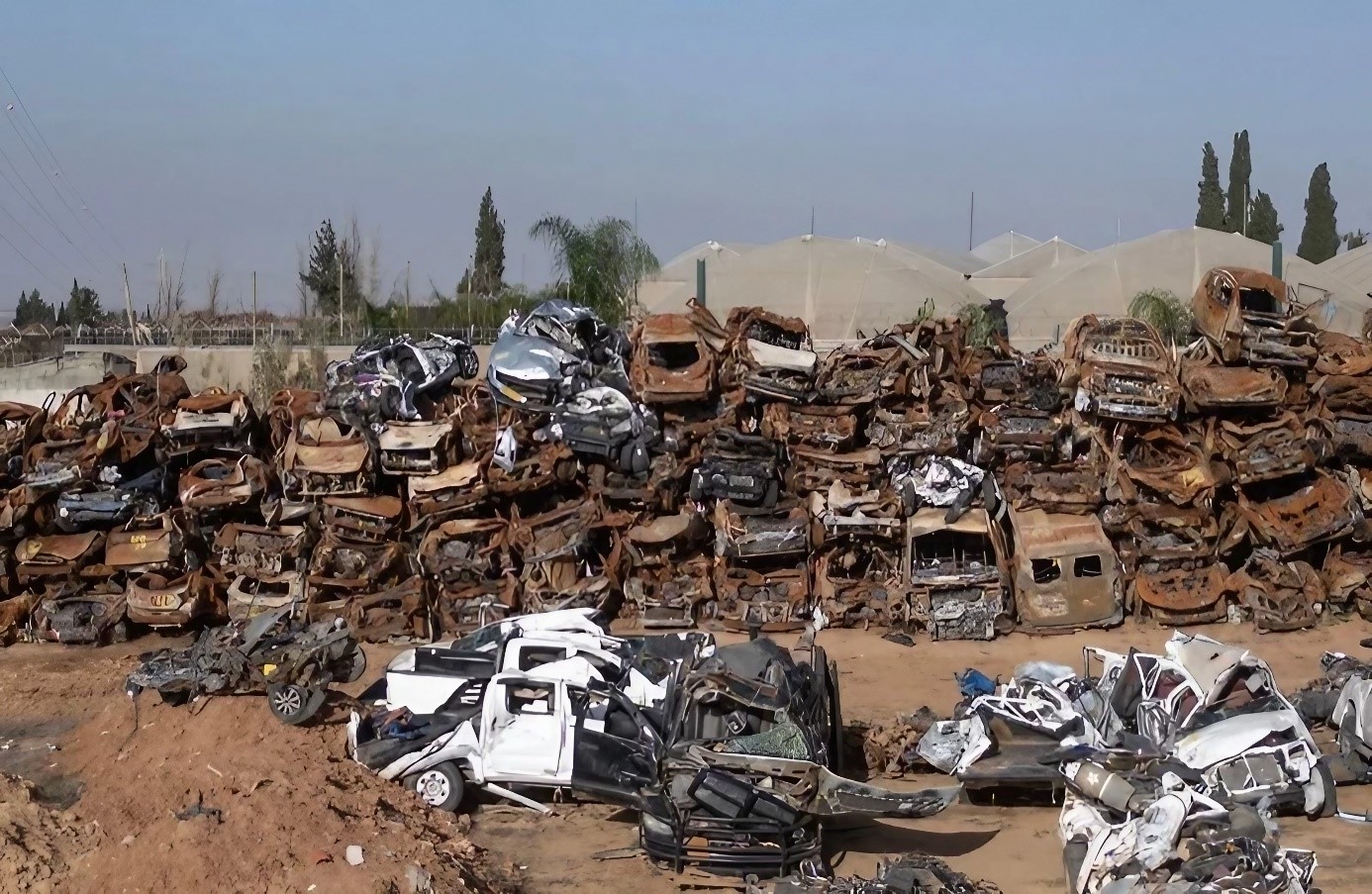
Vehicles destroyed by the Israeli army
On October 7th at 12:00 noon, Israel’s top military leadership ordered all units to prevent the capture of Israeli citizens “at all costs.” The military “instructed all combat units to implement the Hannibal Directive in practice, without expressly using that name,” as the Israeli journalists revealed.
The information comes from an investigative article by Ronen Bergman and Yoav Zitun, two journalists with extensive sources within the Israeli military and intelligence apparatus. They also revealed that Israeli attack helicopters, drones, and tanks destroyed approximately 70 cars driven by Palestinian fighters. ³⁰
It is noteworthy that this information is available in Israel. It is known that the nation’s, the collective’s, interests take precedence over everything, and individuals are sacrificed. Many Israelis accept this; they firmly believe in the story that has been drilled into them for a lifetime: Israel and Zionism are the salvation of the Jews. Only a strong Israel and the IDF stand between them and a second Holocaust; Shapiro calls it the Zionist Holocaust religion.
The willingness of the Zionist leadership to sacrifice individuals on the altar of the nationalist project existed from the beginning and cannot be explained by the Holocaust alone. Nevertheless, it is a fanaticism that can perhaps best be understood from the experience of humiliation and weakness in the face of the pogroms in Eastern Europe and the hatred of traditional, violence-rejecting Judaism. One of the many literary figures among the early Zionists put the creed of the new, the iron, self-sacrificing human being into verse:
“Iron, from which everything is made that the national machine needs. Does it need a wheel? Here I am. A nail, a screw, a girder? Here I am. Police? Doctors? Actors? Water carriers? Here I am. I have no qualities, no feelings, no psychology, no name of my own. I am a servant of Zion, prepared for everything, bound to nothing, with a single commandment: Build!”
Genocide Summer Camp
The event before the Western Wall begins to disperse. I have seen enough and made my way back to the hotel. Lying on the narrow bed in the room, I write an email to the editorial office of the independent English-language news magazine “Electronic Intifada” (EI).
I describe the scene before the Western Wall, attach some photographs, and offer to write a piece about the grotesque staging—the “Genocide Summer Camp.” I will regret this offer a few days later, but at this point, I do not yet know that Israeli security services interrogate tourists not only upon entry but also before departure.
The weekly livestream of “EI,” moderated by four journalists, is one of the best sources of information about the crime of the century in the Gaza Strip. In Germany, “EI” is incorrectly classified as antisemitic. “EI” supports the right of Palestinians to armed resistance against colonization and occupation. In this, the magazine’s editorial team is in accordance with international law; under international law, states may not use force against the exercise of the right to self-determination.
Those seeking self-determination have the right to use military force when no other means are available to achieve their goals. I have watched more than 100 hours of their coverage and found no indication of an antisemitic attitude at “EI.” On the contrary, prominent Israeli dissidents such as the historian Ilan Pappé and the economist Shir Hever are regular guests on “EI.”
Annalena Baerbock’s Relationship with the Truth
An “EI” story of particular interest for Germany: the dissemination of atrocity propaganda by the German Foreign Minister. The article shows how lies about atrocities are used to justify Germany’s support for Israel’s actions in the Gaza Strip.
On May 26, 2024, Minister Baerbock claimed, during a visit to Israel, to have seen a video recorded by Hamas fighters on October 7, 2023, showing the rape of an Israeli woman. This claim, however, was refuted by Israeli media and a UN team, who confirmed that no such video exists.
The accusations of mass rapes by Hamas fighters on October 7, 2023, were the atrocity story that followed the 40 beheaded babies. The story of the 40 beheaded babies was exposed as a lie just days after its first publication and is now heard less frequently.
The claim that the Hamas guerrillas systematically raped women during their commando operation, carried out under extreme time pressure, is also inaccurate, but this story has become lodged in the public consciousness. A UN report published in June 2024 concluded that there is no reliable evidence of rapes. Here is the relevant paragraph of the report:
“With regard to rape, the Commission has seen publicly available reports alleging that Israeli civilians were victims of rape and other forms of sexual violence on 7 October at various locations in southern Israel. The Commission has examined witness statements from journalists and the Israeli police regarding rapes, but was unable to independently verify these allegations, as it had no access to victims, witnesses, and crime scenes, and its investigations were obstructed by the Israeli authorities.
The Commission was unable to review the unedited version of such witness statements. For the same reasons, the Commission was also unable to verify reports of sexualized torture and genital mutilation. Furthermore, the Commission found that some specific allegations were false, inaccurate, or contradicted by other evidence or statements, and excluded these from its assessment.” ³¹
This is not to say that no women were mistreated on October 7, 2023, or that many uninvolved civilians were not murdered. The terrorists indiscriminately murdered civilians — the UN report just quoted leaves no doubt about that. Particularly at the “Nova” festival, horrifying scenes unfolded:
“Around 8:00 AM, Palestinian fighters reached the main grounds and began shooting at fleeing and hiding festival-goers. Palestinian fighters essentially held the festival grounds under their control until at least 12:30 PM and fired at will. Survivors who fled on foot across open fields to the east described the experience as ‘like shooting ducks,’ and ‘the perpetrators drove motorcycles and golf carts across the field and shot at the fleeing festival-goers.’” ³²
Social Media Propaganda Campaigns
Weighing horrific acts of violence against each other is not helpful for the attempt to understand the root causes of the problem. Supposing the rapes invented by Israeli propaganda had actually occurred, would they be a justification for the collective punishment of the civilian population in Gaza? Would the systematic use of sexual violence by Hamas change the fact that Israel is a settler colony that could only come into existence through ethnic cleansing?
What is relevant regarding the atrocity propaganda of mass rapes is the observation of how effective, cynical, and simultaneously reckless Israeli propaganda has become. As the UN report shows, Palestinian attackers on October 7th brutally and indiscriminately killed uninvolved civilians. Israeli propagandists used this fact for a large-scale communications campaign. They wanted to ensure that the world public would not turn away from Israel’s side even after the beginning of the carnage in the Gaza Strip:
“Immediately after October 7th, Israel launched a massive advertising campaign to illustrate the horrors of the Hamas massacre. An examination of the evidence revealed that in the first ten days, Israel ‘flooded’ social media with at least 70 advertisements, including videos with graphic images, reaching millions of people.
Approximately 30 advertisements were completely removed from Google’s public library due to the violent images they contained. Another investigation found that in fewer than two weeks, Israel targeted audiences in Western Europe with approximately 88 advertisements and spent $7.1 million to reach nearly one billion impressions.” ³³
Initially, world public opinion was fully on Israel’s side, and the Israeli media campaign amplified this effect. But after the images of October 7th were displaced by the horrifying images from Gaza, a story appeared in the New York Times at the end of December 2023, in which “systematic rapes” were mentioned for the first time. According to the Times article, a young woman named Gal Abdush was also supposed to have been a rape victim.
Shortly afterward, Abdush’s relatives came forward and accused the Times reporters of lying and manipulation: “Not only did Abdush’s sister and brother-in-law deny that she was raped, but the former also accused the Times of manipulating her family into participating in the campaign through misleading information about the editorial approach.” ³⁴
In Germany, to my knowledge, there was no reporting on the exposure of this atrocity propaganda placed in the supposedly reputable Times, and the UN report also went unmentioned. What remained in memory is the image of the brown man, crazed with hatred and lust — the Islamic barbarian who rapes innocent white women.
For Israeli propaganda, evidence is irrelevant, and new atrocity fantasies kept being added: In his speech before the American Congress, Netanyahu fantasized about murdered children in attics, in order to evoke Holocaust associations through the figure of Anne Frank, who hid in an attic.
Dark Tourism
The equation of the Holocaust with October 7th is part of the Israeli communications strategy. As I write this, eight months after my stay in Israel, a large-scale, multimedia cult of remembrance around October 7, 2023, has emerged there, described by Canadian author Naomi Klein in the article “How Israel Has Made Trauma into a Weapon of War” for the Guardian as follows: The Israeli government “justifies a genocide in the present with a genocide in the past — while its supporters use art, film, virtual reality, ‘dark tourism,’ and even fashion to project Israeli trauma to the entire world.”
In doing so, the propagandists draw on developments of methods already tested at the “Palmach” Museum: immersive experiences that let the visitor feel and relive. The goal is not healing or education, but manipulation and narrowing of perspective. Klein cites Amy Sodaro from City University of New York in her article, who says: “There is a difference between understanding an event, which preserves the analytical capacity of the mind as well as self-awareness, and the feeling of personally living through it.”
The latter does not lead to understanding but to what Sodaro calls a “prosthetic trauma” that, as she writes, contributes greatly to a “simplifying dualism between good and evil with important political implications.”
The consumers of these experiences are encouraged to feel a kind of distilled bond with the victims, who embody the essence of good, and a distilled hatred of their attackers, who embody the essence of evil. ³⁵
Unequal Citizens
I have no desire to leave the hotel room again and research recruitment and military service in the Israeli army. The IDF is a conscript army; every Israeli citizen of Jewish nationality (until recently, with the exception of ultra-Orthodox Jews) must serve between 24 and 32 months of military service.
This applies to men and women, but not to the Palestinian “citizens” of Israel, and only with restrictions for other population groups such as Druze and Circassians. Israel is the only modern nation-state that distinguishes between citizenship and nationality. In searching for a detailed explanation, I come across a report by Amnesty International that describes the apartheid system in Israel. The report is extensive — 280 pages. I search for the relevant passages and find this:
“Military service in Israel is compulsory for Jewish Israeli men and women, as well as Druze and Circassian men in Israel. Palestinian citizens of Israel are exempt and have largely not served in its army since the founding of the State of Israel in 1948 for national and political reasons. The exemption is not enshrined in law but was introduced as an administrative practice, based on the Israeli army’s discretionary powers under the provisions of the Military Service Law of 1986.
No Housing Allowance Without Military Service
Israeli citizens who complete military service receive substantial financial compensation from the state, access to jobs in certain sectors such as the military and security industry, and access to housing allowances. The Absorption of Discharged Soldiers Law of 1994 and its subsequent amendments provide a broad range of benefits exclusively for former soldiers, including educational grants and housing allowances.
By linking benefits to military service, the state ensures that the overwhelming majority of Palestinian citizens of Israel are excluded from these benefits. While the minority of Jewish Israelis who do not serve in the army are also denied access to these benefits, they at least have a meaningful choice.
For almost all Palestinian citizens of Israel, it is unthinkable to serve in an army that occupies Palestinian land and systematically suppresses the rights of Palestinians. The linking of benefits and military service has been the subject of public debate in Israel for decades, with the focus on the idea of using a compulsory alternative national service for Palestinian citizens of Israel or the exclusion of Palestinians from military service to justify the privileges that Jewish Israelis enjoy for serving in the army.” ³⁶
Lived Apartheid
What would the reaction be in the Fatherland if Germany distinguished in this way between purebred Germans and German citizens of Turkish descent? Would Björn Höcke be in favor, or would that go too far for him?
Israel operates two strictly separated school systems — one for the Jewish, Hebrew-speaking majority and one for the Palestinian, Arabic-speaking minority. The ostensible rationale is that this arrangement takes sociocultural differences into account, but it is really about maintaining the differences between the two groups and protecting the privileged situation of Jewish Israelis.
Unlike Jewish students, who read the literature and poetry of the Zionist movement, celebrating the founding of Israel in 1948, Palestinian students do not read the literary classics taught in the Arab world. They also learn nothing about the “Nakba” or the history of the Palestinians.
They must engage with Jewish values and Jewish culture. Although Arabic is the language of instruction at Palestinian schools, Palestinian students spend significantly more time studying Hebrew, Jewish history, and Jewish culture than Arabic literature and history. ³⁷
What would the reaction in Germany be if there were separate school systems for purebred Germans and Germans with a migration background?
These examples of unequal treatment, however, seem like insignificant details when compared with the massive, life-threatening discrimination to which Palestinians in the occupied territories and the Gaza Strip are subjected.
The situation of the more than 300,000 Palestinians in occupied East Jerusalem is described in the Amnesty report as follows: “Palestinians in East Jerusalem, on the other hand, can participate in political life neither in Israel nor in the West Bank. While they can vote and run in municipal elections in Jerusalem, they have traditionally boycotted them in protest against Israel’s ongoing occupation and illegal annexation of East Jerusalem and remain excluded from national elections.”
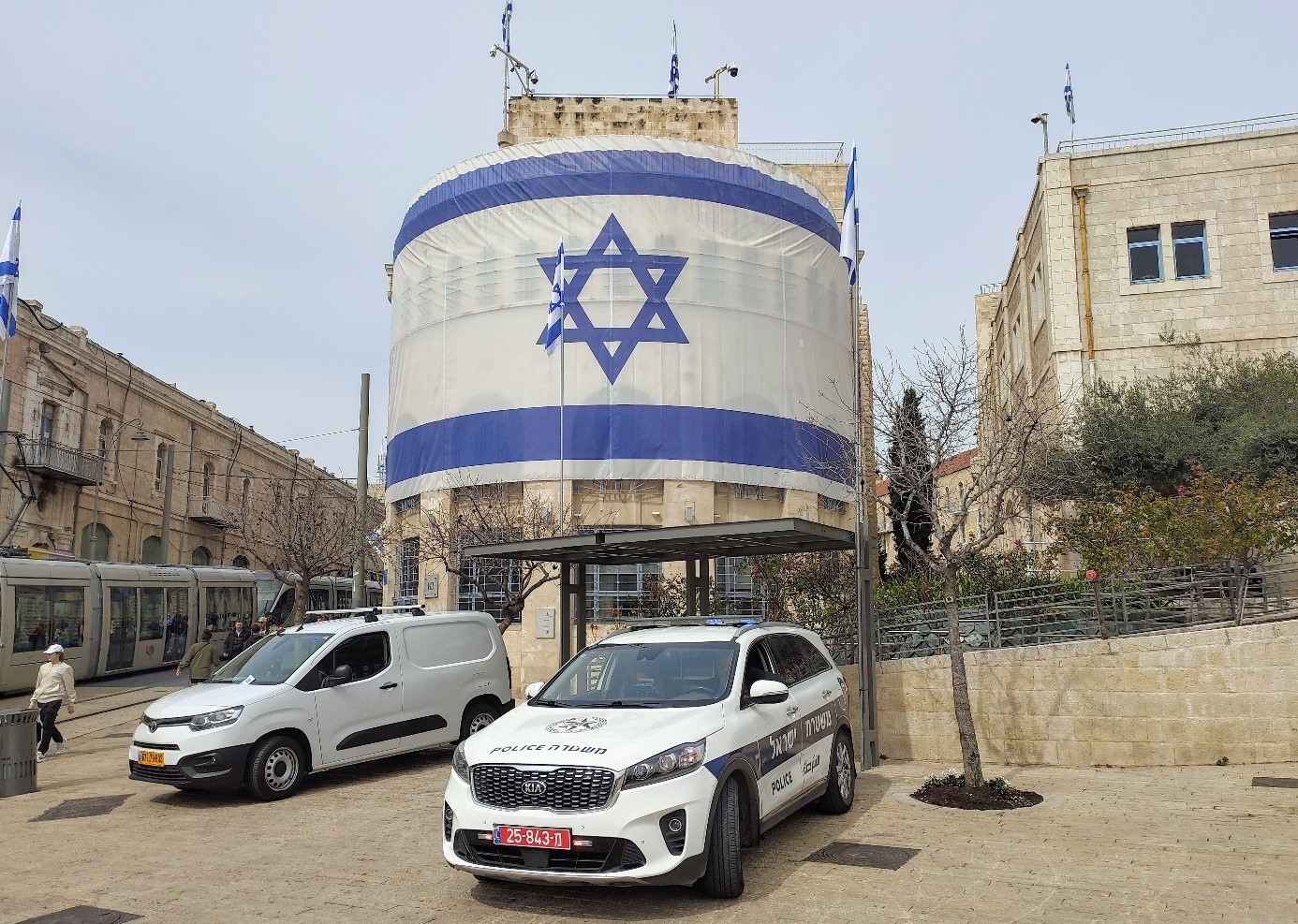
Israeli police station in occupied East Jerusalem
But that is not all: Palestinians in East Jerusalem are subject to a whole series of additional “special regulations”: “Palestinian residents of East Jerusalem are not Israeli citizens. Instead, they are granted an insecure permanent residency status that allows them to live in Jerusalem and access social services.
Center of Life Revoked
Through discriminatory laws and policies, however, the Israeli authorities have revoked the status of thousands of Palestinians, including retroactively, if they cannot prove that Jerusalem is their ‘center of life.’ This has devastating consequences for their human rights. In contrast, Jewish Israeli settlers living in East Jerusalem enjoy Israeli citizenship and are exempt from laws and measures enacted against Palestinian residents of East Jerusalem.”
How and where do the Palestinians in East Jerusalem live?
“In July 2021, 358,800 Palestinian residents lived within the borders of the city of Jerusalem, accounting for 38% of the city’s population. Of these, approximately 150,000 live in areas separated from the rest of the city by the wall and other military checkpoints. Approximately 225,178 Jewish Israelis live in East Jerusalem in 13 illegal settlements built by the Israeli authorities and in private homes taken over from Palestinians under discriminatory programs.”
What is the goal?
“Since the annexation of East Jerusalem in 1967, Israeli governments have set targets for the demographic ratio of Jews to Palestinians in Jerusalem as a whole. In several resolutions, Israeli governments endorsed a 70% to 30% target ratio. In 2006, the target was revised as part of the Regional Master Plan 30/1.
In 2009, a new target of 60% Jews to 40% Palestinians, established in the ‘Jerusalem 2000’ plan, was deposited with the Regional Planning Committee. Statements by Israeli politicians suggest that the denial of economic and social rights for Palestinians in East Jerusalem is not merely a consequence of Israel’s dispossession and segregation policies but is rather intentional.
Thus, Teddy Kollek, the then Mayor of Jerusalem, said in 1990: ‘For Jewish Jerusalem, I have done something in the last twenty-five years. For East Jerusalem? Nothing! What have I done? Nothing. Sidewalks? Nothing. Cultural institutions? Not one. Yes, we installed a sewage system for them and improved the water supply. Do you know why? Do you think it was for their benefit, for their welfare? Forget it! There were some cases of cholera there, and the Jews were afraid they would catch it, so we installed a sewage system and a water system against cholera.’”
Israel for the Jews, Foreigners Out
Anyone who wants to understand Israel cannot avoid the demographic problem — that is, the expulsion of the Palestinians from the Jewish state. Israel for the Jews, foreigners out; as so often, it is not necessary to search through secret documents — the Zionist leadership elite has long since stopped mincing words.
When then-Prime Minister Benjamin Netanyahu posted a message on Instagram in March 2019 saying that “Israel is not a state of all its citizens” but rather “the nation-state of the Jewish people and only that,” he crystallized a policy that had been in the making for seven decades.
As early as December 2003, when he was Finance Minister, Benjamin Netanyahu said: “If there is a demographic problem, and there is, it is with the Israeli Arabs who will remain Israeli citizens.” He pointed to the need to pursue a policy aimed at integrating “Israel’s Arabs” while ensuring they do not constitute 35% to 40% of the population.
Those Down There Who Keep Bashing Each Other’s Heads In
Benjamin Netanyahu was indeed criticized for his 2003 remarks, but they were not the views of an outlier. Yitzhak Rabin, his predecessor as Prime Minister, said: “The red line for Arabs is 20 percent of the population; that must not be exceeded.” Ariel Sharon, as Prime Minister, said in a 2002 Knesset debate that Palestinian citizens did have “rights in the land,” but “all rights over the Land of Israel are Jewish rights.”
Ehud Olmert said in 2003, as Deputy Prime Minister and three years before becoming Prime Minister, that “the demographic question” would “dictate the solution we must apply,” and that the “formula for the parameters of a unilateral solution is: maximize the number of Jews; minimize the number of Palestinians.”
Many Germans think Israel was founded by faithful Jews, religious fanatics, as an understandable reaction to the Holocaust, and that Jewish fanatics are now clashing with fanatical Muslims. That is certainly one of the reasons for the popularity of the phrase about “the fanatics down there who have been bashing each other’s heads in for centuries.”
One More Gene for Reason
What resonates with some people here is a cozy folk racism that, over a third beer, ruminates on the differences between people and tells itself that we Germans simply have one more gene for reason than those people down there. This racism comes across as more good-natured than Churchill’s formulation, but the two are closely related.
But many Germans also simply do not know that the situation in Palestine is comparable to the colonial history of Vietnam, South Africa, Algeria, or the United States. The indigenous population is defending its land against European newcomers who have established a colony. It is not a conflict that has been going on since time immemorial. It begins with the Zionist movement’s decision to establish its colony in Palestine.
The nationalist ideology of the European settlers — Zionism — is a flexible, pragmatic ideology that does not care about God and permits cooperation with anyone who can be helpful in achieving the goal of maintaining and expanding the colony. The Zionists want to settle the land and use Jewish religious fanatics just as they use the frequently antisemitic, fundamentalist Christian fanatics in the USA.
Violence Is Part of Every Liberation Struggle
In Europe, the situation in Palestine is most comparable to the history of Ireland, which is probably why many Irish people understand the plight of the Palestinians better than the Germans. Ireland was England’s first colony. The country was part of the English and later the British Empire for 700 years. The Irish forced the establishment of their own state in 1922 through a bloody guerrilla war.
Rashid Khalidi, emeritus Professor of History at Columbia University in New York, states the undeniable historical truth in an interview with the Israeli newspaper Haaretz: “I am no friend of violence, but I am aware that violence is an essential part of every liberation struggle. Against the overwhelming violence of the colonial rulers, there will be violence, whether I want it or not.”
Khalidi also points to important differences between the situation in Palestine and the confrontation between indigenous peoples and European settlers in other countries: “If you’re talking about the French in Algeria, I would argue that placing a bomb in a café violates both moral and state laws; it is a violation of international humanitarian law.
Two heroines of the Algerian Revolution — Jamila Bouhired and Zahra Zarif — did that. On a political level, that is, in my view, debatable, because the colonists, French settlers in Algeria, ultimately have a place to return to. They suffer from what I call ‘colonial anxiety.’ They are afraid of the ‘indigènes,’ the indigenous population, because the ‘indigènes’ outnumber them, and they know the ‘indigènes’ resent them.
But they do not suffer from an innate fear of persecution. Unlike the Jewish Israelis, they have no narrative in which every attack on them is placed in this context rather than in the local context. And ultimately, this violence was successful. Morally speaking, the attitude toward indiscriminate violence is black and white. But politically speaking, it is gray.”
Khalidi also highlights in the conversation the particular difficulty of the Palestinian liberation struggle: “It is harder than any other liberation struggle because it is not directed against a colonial project where the people can go home. There is no home. The Jews have been living in Israel for three or four generations. They are not going anywhere. You can’t simply appeal to them as you could to the French to bring their colonists home. It is more like Ireland and South Africa, where you have to come to terms with a population that you regard as a foreign group but that has become rooted and has developed a collective identity.” ³⁸
Similar to the topic of the “Nakba” — that is, the ethnic cleansing of the Palestinians as a precondition for the “Jewish and democratic” state — there is complete agreement in serious academic discourse regarding the fact that Zionism was and is a colonial project. Given the evidence, this is hardly surprising. What is more remarkable is that these fundamental facts have so far not found their way into the general public consciousness in Germany through the mass media.
In academic discourse, the debate now centers primarily on the correct definition of the colonial project. The definition I have encountered most frequently in the course of my research is that of the “settler colony.” Settler colonies are characterized, among other things, by the fact that the settlers have no intention of returning to their homeland and do not intend to exploit the indigenous population, the “natives,” for the benefit of the colonial metropole. The primary goal of the project is land theft and the appropriation of resources.
Cleansing, Genocide, and Assimilation
The Palestinians — the indigenous population of today’s Israel — represented and represent a disrupting factor that the colonists want to eliminate. This can happen in various ways; ethnic cleansing and genocide are frequently the means of choice in such situations. But assimilation into the society created by the colonists is also an option. In Israel’s treatment of the Palestinians, as in the treatment of “Indians” — Native Americans — by white Americans, examples of all three variants can be found.
The granting of Israeli citizenship to a portion of the Palestinian population is an example of the Israeli state’s attempt to solve the problem at least partially through assimilation. Until 1966, citizens of Israel of Palestinian descent were subject to a special military regime. Their freedom of movement, as well as freedom of speech and assembly, was restricted.
Indians and Other Natives
An interesting difference between the settler colony of Israel and the settler colony of the USA is the evolution of the media representation of the indigenous people and their resistance to land theft, ethnic cleansing, and genocide. The depiction of Native Americans as bloodthirsty savages, as barbarians and natural enemies of the civilized white man, appears today — at least to part of the audience — as implausible and racist. John Wayne has outlived his usefulness as a heroic figure. This does not, however, prevent German journalists like Christian Schröder from writing paragraphs like this one for the Tagesspiegel as recently as 2007:
“It is about taming the wilderness, and the men who push the boundaries of civilization ever further westward are taciturn conquerors who obey no law but their own morality. They would rather go down fighting than submit. No other actor embodied these pioneer-era virtues — which correspond to the American Constitution’s promise of happiness for every individual citizen — as convincingly as John Wayne, who was born one hundred years ago today in Iowa. He is the greatest American hero that the twentieth century produced.” ³⁷
Hard Men, Brutal Methods
Taciturn conquerors, hard men who use brutal methods to tame the wilderness. It is the same sound familiar from Netanyahu. It is astonishing how persistent the most simplistic clichés about the United States are in Germany, while the fictional character “John Wayne,” created by the actor Marion Robert Morrison, is rejected by the younger generation in the USA itself as a negative example of a dishonest, “toxic” form of masculinity.
Within the Western genre, there has been an evolution since the days of John Wayne. In the film Dances with Wolves, for example, which made Kevin Costner a world star in 1990, one can at least observe the attempt to depict Native Americans in a more realistic, less racist way. This kind of evolution is largely absent in action films with Muslim or Arab characters.
Here, Arabs and Muslims appear primarily as bearded, barbaric terrorists. Hollywood productions like the Chuck Norris classic Delta Force or the courtroom drama Rules of Engagement starring Pulp Fiction star Samuel L. Jackson are just two of many examples of this kind of subliminal propaganda. ³⁸ It is this kind of omnipresent, entertainment-wrapped propaganda that enables the dehumanization of the Palestinians.

I wrote this essay because I am horrified that the German government has supported the massacre in Gaza. As a German citizen, I am disgusted by the misuse of Holocaust remembrance to support a genocide.